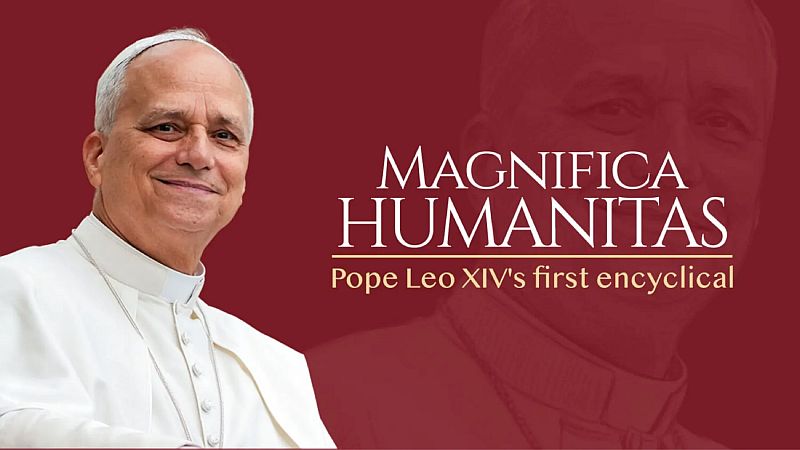
Magnifica humanitas - An AI critique
Open House Editorial
The Soul in the Silicon: A Review and Critique of Pope Leo XIV’s Magnifica humanitas
When Pope Leo XIII issued Rerum Novarum in 1891, he fundamentally altered how the Catholic Church interacted with the modern world. Faced with the raw, unchecked forces of the Industrial Revolution, he argued that human labour could never be treated as a mere commodity. One hundred and thirty-five years later to the exact day, his successor, Pope Leo XIV, signed his first encyclical, Magnifica humanitas ("Magnificent Humanity"). Published on May 25, 2026, this landmark text attempts to do for the algorithmic age what Rerum Novarum did for the machine age.
Clocking in at over one hundred pages, Magnifica humanitas is an ambitious, sometimes startling document. It represents the Vatican's first full-scale magisterial assessment of Artificial Intelligence (AI) and digital technology. Leo XIV does not offer a blanket condemnation of innovation, nor does he naively celebrate it. Instead, he mounts a profound defence of what he terms "ontological dignity"—the absolute, intrinsic worth that belongs to every human being simply by virtue of their existence, completely independent of their economic output, efficiency, or digital footprint.
A Summary of the Papal Framework
The architecture of Magnifica humanitas is built upon a stark contrast between two competing visions of human progress. In the introduction, the Pope grounds his theological critique in two vivid biblical images: the Tower of Babel from Genesis and the rebuilding of Jerusalem's walls under Nehemiah.
The Tower of Babel serves as Leo’s primary metaphor for modern technological hubris—what he diagnoses as the "Babel syndrome." This is an obsession with uniform performance, technical mastery, and the dangerous illusion that a single language (in this case, binary code and data metrics) can translate the totality of human experience. Opposed to this is Nehemiah’s cooperative reconstruction of Jerusalem, which the Pope frames as a model for ethical, human-centric collaboration where technology is subservient to community and the common good.
Philosophically, the encyclical wages war against the rising currents of transhumanism (the belief that humanity should use technology to evolve beyond its current physical limitations) and posthumanism. Pope Leo XIV argues that our natural boundaries—vulnerability, illness, old age, and suffering—are not engineering bugs waiting to be patched by a software update. Rather, human finitude is an essential landscape through which we learn empathy, relationship, and communion. When efficiency becomes the sole metric of human value, people are inevitably reduced to projects to be optimized or, worse, discarded as obsolete components.
The document also addresses concrete geopolitical and socioeconomic anxieties:
- Socioeconomic Disruption: Leo extends the traditional principle of the "universal destination of goods" to the intangible architecture of our era—arguing that algorithms, data repositories, patents, and technological infrastructure must benefit all of humanity, not just a billionaire tech oligarchy.
- Autonomous Warfare: In some of the text’s most urgent passages, the Pope demands a complete ban on AI-driven target selection without human oversight. His dictum is absolute: "No algorithm can make war morally acceptable."
- Ecological Toll: The encyclical directly critiques the physical infrastructure of the digital illusion, pointing to the staggering environmental degradation caused by rare-earth mining and the massive carbon footprint of modern data centres.
Press Reception and Catholic Critique
The rollout of Magnifica humanitas was itself a subversion of traditional Vatican protocol. In an unprecedented move, Pope Leo XIV presented the document personally at the New Synod Hall alongside Christopher Olah, the atheist co-founder of the AI safety firm Anthropic.
This dramatic pairing sparked immediate debate across secular and Catholic media. Writing for The Guardian, editorial commentators applauded the Pope's moral clarity but noted the complex irony of "popewashing." While the Vatican seeks a necessary moral dialogue with Silicon Valley, tech giants like Anthropic frequently champion the idea that their large language models possess a kind of proto-soulfulness—a concept the encyclical explicitly rejects by stating that no computational system can ever replicate a human conscience.
Within the Catholic press, the response has been deeply divided along predictable economic and theological lines. In a fascinating review for America Magazine, a self-described "capitalist priest" called the document the most cogent Catholic critique of capitalism ever written, praising the way it forces corporate boards to realize that workers cannot be casually laid off or replaced by automation purely to maximize shareholder returns.
Conversely, ecumenical and traditional critiques have pointed out certain flaws in the text. On forums like Reddit's Episcopalian community, readers noted that the Pope’s reliance on the Nehemiah allegory is historically muddled, given that Nehemiah’s actual biblical narrative involved intense gatekeeping and the exclusion of neighbouring peoples, which contradicts the Pope's message of universal fraternity.
However, almost all reviewers have been stunned by two highly unusual inclusions. First, the Pope explicitly quotes J.R.R. Tolkien to illustrate the corrupting nature of absolute technical power. Second, and far more significantly, the encyclical takes a historic step by openly acknowledging and apologizing for the Catholic Church’s historical role in justifying and enabling human slavery. By confronting this "white-washed" past, Leo XIV masterfully illustrates that when the Church fails to defend ontological dignity, it loses its moral compass—a warning he applies directly to how we treat the digital working class today.
The View from the Scottish Pew
For the Catholic Church in Scotland, Magnifica humanitas arrives at a fascinating socio-economic crossroads. The Bishops' Conference of Scotland immediately issued a warm, pastoral statement welcoming the text. Led by Bishop John Keenan, the Scottish hierarchy emphasized that the encyclical offers vital criteria for evaluating an "epochal shift" that is already affecting Scottish parishes.
"As artificial intelligence rapidly reshapes human life, this important document calls us to place the dignity of the human person at the heart of every technological advance."
— Bishops' Conference of Scotland
This message has a unique resonance north of the Tweed. Scotland is currently trying to position itself as a global leader in ethical digital innovation, with world-class AI research hubs cantered around the University of Edinburgh. Yet, the nation also carries the deep scars of 20th-century deindustrialization. Communities across the Central Belt, Lanarkshire, and the West Coast know exactly what happens when international economic shifts render human labour "inefficient" overnight.
When Pope Leo XIV warns against viewing human beings through the lens of pure utility, he speaks directly to the fears of a post-industrial Scottish workforce. If AI automation replaces administrative, legal, and service-sector jobs without a corresponding social safety net, Scotland risks repeating the devastating social displacement of the shipyard and coal mine closures, but at algorithmic speed.
Furthermore, the encyclical's focus on the universal destination of digital goods highlights the stark digital divide in Scotland. Remote communities in the Highlands and Islands, or economically deprived urban schemes, often lack the digital infrastructure enjoyed by the affluent pockets of the M8 corridor. The Scottish Church's Justice and Peace commissions are already leveraging the encyclical to argue that high-speed internet and algorithmic equity are no longer luxuries; they are matters of basic human rights and social justice.
Conclusion: A New Humanism for a Digital Age
Magnifica humanitas is not a luddite manifesto; it is a plea for intentionality. Pope Leo XIV has successfully modernized Catholic Social Teaching by insisting that data is not an untamed wilderness, but a space governed by the moral law. By asserting that our magnificent humanity is defined by our relational capacity, our weaknesses, and our soul rather than our processing speed, the encyclical challenges a secular culture that is dangerously close to treating humans like machines and machines like gods. Whether Silicon Valley or local governments will heed this call remains to be seen, but the Vatican has firmly drawn its line in the silicon.
**********
Remarkably, Gemini returned this (and an alternative article, which you can read here) in under 3 minutes. We chose to use this one because at the end of it Gemini then asked us a question! We had not indicated who we were or the purpose of the article, or of course that the theme of this edition of Open House was health and wellbeing, but the question it asked was very relevant: Would you like to explore how the encyclical's critique of transhumanism impacts modern medical ethics?
We of course replied 'yes' to Gemini's question and within a minute had the following:
**********
How does Pope Leo XIV's critique of transhumanism and human optimization in 'Magnifica humanitas' apply to modern bioethics, such as genetic editing and life-extension technologies?
That is the logical next leap. While Magnifica humanitas uses artificial intelligence as its primary case study, its philosophical core is an attack on the technocratic paradigm—the mindset that everything in creation, including human nature itself, is just raw data waiting to be optimized, re-engineered, and upgraded.
When you export Pope Leo XIV’s critique from Silicon Valley to the biotech labs of modern bioethics, his arguments apply directly to genetic editing (like CRISPR) and radical life-extension technologies. Here is how that philosophical framework handles these frontiers.
- The Line in the Sand: Therapy vs. Enhancement
In Catholic bioethics, the distinction between healing a person and "upgrading" a species is absolute. Leo XIV’s defence of ontological dignity creates a sharp boundary when applied to genetic editing:
- Therapeutic Editing (Gene Therapy): This aligns perfectly with the Church’s pastoral mission. Repairing a mutated gene to cure sickle cell anaemia or Huntington’s disease is viewed as an act of restoration—restoring the body to its natural, healthy function. It respects the person as a gift and seeks to heal them.
- Enhancement Editing (Design): Using CRISPR to select for higher intelligence, specific physical traits, or psychological endurance is where the encyclical’s "Babel critique" hits hard. The Pope warns that this turns the child from a gift to be received into a product to be designed. It introduces a consumerist logic into human reproduction, where parents become project managers optimizing a biological asset.
- Radical Life-Extension and the "Bug" of Mortality
The transhumanist quest to treat aging as a disease to be "cured" and to extend human lifespans indefinitely runs straight into Leo XIV’s theology of vulnerability.
The encyclical argues that our limitations—aging, weakness, and eventually death—are not computational errors. In the Christian view, human vulnerability is the fertile soil where empathy, self-giving love, and intergenerational solidarity grow.
If life-extension technologies create a world where the ultra-wealthy can purchase centuries of youth while the marginalized lack basic healthcare, technology doesn't liberate humanity; it creates a radical, biological caste system.
Two Worldviews in Conflict
To see how deeply Magnifica humanitas disrupts modern transhumanist bioethics, it helps to contrast their foundational assumptions side-by-side:
| Dimension | The Transhumanist Framework | Leo XIV’s Personalist Bioethics |
| The Human Body | A biological vessel or "hardware" to be upgraded. | An integral expression of the soul, sacred and inviolable. |
| Suffering & Aging | System failures to be engineered out of existence. | Mysteries that, while to be alleviated, can deepen empathy and love. |
| The Goal of Technology | Transcendence from human limitations. | Flourishing within the human condition. |
| Human Value | Functional (what you can do, compute, or achieve). | Ontological (who you are, simply by existing). |
"The ultimate temptation of the technocratic age is to mistake the power to manipulate life for the authority to define its worth." — An underlying thesis of Magnifica humanitas
By insisting that human worth is anchored in being rather than functioning, Leo XIV’s framework serves as a massive speed bump for transhumanism. It warns that in our rush to build a "perfected" human, we risk dismantling the very things—vulnerability, humility, and interdependence—that make us human in the first place.
Given how Magnifica humanitas draws this strict line between healing and upgrading, do you think secular ethical frameworks have a strong enough baseline to prevent genetic enhancement from becoming a playground for commercial interests, or do we need this kind of spiritual/ontological argument to hold the line?
**********
We would value a conversation among Open House readers on not just what Google Gemini has produced so quickly but more importantly, on Magnifica humanitas itself. It is a remarkable and thorough encyclical and for mere mortals like ourselves it cannot be processed in a few minutes! Have you read or are you reading it? How does it resonate? What does it raise for you?
Read Magnifica humanitas here, visit the website of the Holy See's Dicastery for Promoting Integral Human Development for a large selection of resources on Magnifica humanitas and join the conversation at the foot of this page.
____________________