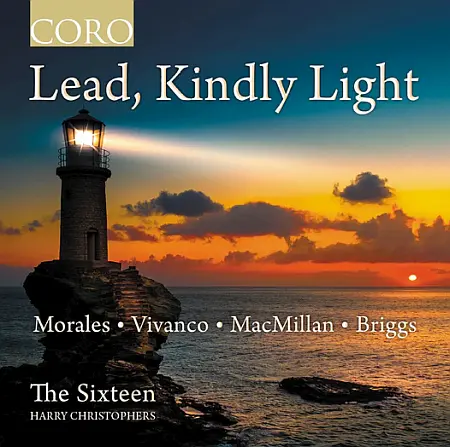
The Sixteen: ‘Lead, Kindly Light’ (The Choral Pilgrimage 2026), directed by Harry Christophers
by Paul Matheson
https://cororecords.com/products/new-lead-kindly-light-album-by-the-sixteen
Spain’s Siglo de Oro, the Age of Gold, gave rise to some of the greatest sacred choral music of the Renaissance. Lead, Kindly Light showcases the music of two outstanding Spanish composers from successive generations of that Golden Age: Cristóbal de Morales (c.1500-1553) and Sebastián de Vivanco (c.1551-1622).
The compositions of Cristóbal de Morales were famous across Europe and the New World, and the exquisite polyphony of Sebastián de Vivanco graced the religious services of the cathedrals of Ávila and Salamanca during the late 1500s. The Sixteen’s 2026 Choral Pilgrimage programme also contains two recently commissioned pieces by contemporary British composers, Scotland’s James MacMillan (b.1959) and Cornwall’s Kerensa Briggs (b.1991): both pieces are settings of poems by the 19th century English theologian, Cardinal and Saint, John Henry Newman.
Turning first to the Spanish composers. Sebastián de Vivanco’s Christus factus est pro nobis is a motet setting of text from a letter of St Paul (Philippians 2: 8-9), composed to be the Gradual for Maundy Thursday Mass, and to be sung by 3 choirs of 4 voices each. Vivanco was a priest as well as a singer, composer and Professor of Music at Salamanca’s ancient university. His compositions are acutely sensitive to the meaning of the words of scripture that he sets to music. The opening words ‘Christus factus est pro nobis’ (Christ became for us’) are set to wave after wave of different voices, evoking Saint Paul’s sense of deep, wonderstruck gratitude that God became incarnate as one of us. The interweaving waves of cascading voices unify powerfully on the word ‘obediens’ (‘obedient’ – Christ’s obedience to His sacrificial death for us on the cross). The voices gather together and dwell on that word to let listening worshippers absorb the astonishing revelation of Christ’s love for us. Vivanco uses the overlap between the various cascading voices to repeatedly and movingly combine the word ‘Christus’ (‘Christ’) with the word ‘nobis’ (‘us’), communicating through music the theological truth that He became more like us so that we might become more like Him.
Login or subscribe below to continue reading this article
Paul Matheson is an advisor on equality, human rights and standards in public life.