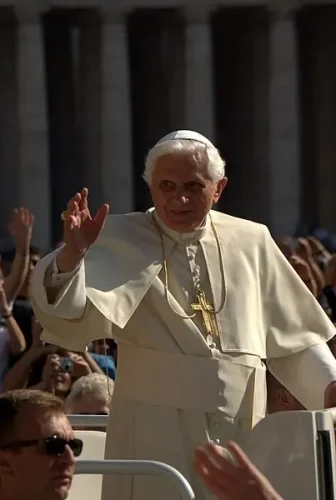
Benedict XVI: A Life Volume Two
by Jim Lawlor
Jim Lawlor reviews Benedict XVI: A Life Volume Two; Professor and Prefect to Pope and Pope Emeritus 1966 – The Present. Peter Seewald. Bloomsbury Continuum, 2021
This second volume of Seewald’s biography of Benedict XVI is a substantial 160 pages longer than volume one, picking up from Ratzinger’s return to Tübingen on the conclusion of Vatican II. In those early days of assimilation of Vatican II Ratzinger was already concerned that the unprecedented media coverage of the Council would distort the meaning of its final texts. This anxiety in him, of a misunderstanding of the Council and the direction of the Church, has been a central motif in the life and ministry of Ratzinger.
The eruption of the student riots of 1968 affected even Tübingen and is often cited to explain Ratzinger’s apparent shift to a more conservative theology. Seewald denies this but it is hard to dismiss since Ratzinger returned to his native Bavaria and a new post in the university of Regensburg just months after the riots in 1969. Just eight years later, in March 1977, he became Archbishop of Munich and Freising, and a cardinal three months later. These five years as Archbishop were to be Ratzinger’s most extended period in pastoral ministry.
While Seewald describes his concern about the undermining of family life, encroaching secularism and his analysis of intellectual currents in culture, there is little about his governance or personal interaction with clergy or lay faithful. (Only weeks ago, the BBC reported his mishandling of four sexual abuse cases during this period).
Ratzinger participated in the conclaves of 1978, ending with the election of Karol Wojtyla, an election which altered Ratzinger’s life forever. By 1981 John Paul II prevailed on the reluctant Ratzinger to become prefect of the Congregation of the Doctrine of the Faith (CDF), a post he held for 24 years. Now on the global stage, the Wojtyla-Ratzinger partnership would shape the church and influence the world for three decades. Seewald, among others, suggests the election of Ratzinger to succeed Wojtyla was inevitable – who better understood the legacy? The eight years as Bishop of Rome were marked by revelations, scandal and misjudgement as well as three concise and lauded encyclicals, but nothing hinted at the resignation of February 11th, 2013, the end point of Volume two
Ratzinger’s story is generously amplified by Seewald, but the author’s partisanship shapes the book in two ways. First, Seewald is in uncritical awe of Benedict. Secondly, Seewald’s profession as a journalist shapes the style but also the content and emphasis of the story.
Even as Ratzinger was concerned about the reception of Vatican II, alternative hermeneutics, notably that led by Giuseppe Alberigo and the Bologna school, presented the ‘spirit of Vatican II’ as ongoing renewal and reception. This is still a live tension, but Seewald’s personal respect for Benedict is unfortunately so blinding and pervasive that he proposes Ratzinger to be the major influence on and the correct interpreter of Vatican II. This is historically simplistic, given the significant periti, bishops and reform movements that shaped Vatican II. By contrast to the seriousness and integrity of his hero, Seewald portrays Hans Küng as the misinterpreter of the Council. In both volumes the portrait of Küng descends to caricature, so I now feel compelled to read Küng’s biography for balance!
Of Ratzinger’s time as Prefect of the CDF, Seewald becomes defensive. The relationship between John Paul II and Ratzinger is well rehearsed, but it is superficial to explain away the actions and culture of the CDF in these decades as Ratzinger simply enforcing the will of the Pope. We get little detail about the suspension of Leonardo Boff, Anthony De Mello, Jacques Dupuis or Matthew Fox. Nor is there much to explain the context of either Dominus Iesu (on the salvific uniqueness of Christ, causing tension with non-Christian faiths), or On the Pastoral Care of the Homosexual Person. To Ratzinger Seewald accredits the Catechism of the Catholic Church (1985) when in fact as CDF Prefect he chaired a committee of 12 Cardinals and a team of theologians.
The Instruction on Certain Aspects of the Theology of Liberation (1984) merits a short chapter but deals more with Ratzinger’s fear of the politicisation of religion, as he witnessed in Nazi Germany, than about the lived experience of the Latin American Church. The analysis of Summorum Pontificum, extending the use of the Tridentine Rite of the Mass, exposes Seewald’s own liturgical preference and the traditional Bavarian spirituality of Benedict XVI. There is no hint at the subsequent polarisation nor the ultimate failure of this initiative.
In the end, this biography cannot be a useful introduction to the theological work and contribution Ratzinger undoubtedly made. Seewald is a journalist who has written on religion for three German newspapers. While his lightness of style makes this an easy read, his background influences the issues to which he gives greater prominence. To illustrate this, Seewald describes the attempt to effect reconciliation with the Society of St Pius X. Close to Benedict’s heart, the move inadvertently raised the well-known fact that one of the illicitly ordained ‘Lefebvriste’ bishops, Richard Williamson, was a holocaust denier.
A profound embarrassment to the Vatican, this caused anger and upset across Germany. It is notable that Seewald devotes considerable space to this story, exposed and reported in the German press where Seewald worked, especially when compared to the reporting of, say, the Vatileaks betrayal or the Regensburg address, offensive to Islam. In every event his default is to defend Benedict, either as misunderstood or badly advised by the Curia.
Is there scope for volume three? After all, Benedict has now been bishop emeritus longer than he was Pope. No further writing on Benedict XVI can ignore these two volumes but there is still scope for a scientifically critical assessment of the Professor-Pope. Interviewed in the Tablet, Jurgen Moltmann (Ratzinger’s contemporary and erstwhile colleague at Tubingen) said that the two were never personally close. Joseph had too anxious a heart. Maybe a starting point for a different story?