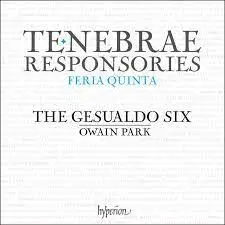
The Gesualdo Six: Tenebrae Responseries
by Paul Matheson
The Gesualdo Six: Tenebrae Responseries – Feria Quinta (Hyperion CDA68348
For Easter 2022, the award-winning British vocal ensemble The Gesualdo Six released an album of sacred music for Maundy Thursday. It was the piece that had first brought them together, years before, as choral scholars at Cambridge, for their first public performance. Years later, they finally recorded the piece in St Jude-on-the-Hill, Hampstead Garden Suburb, London, during the Coronavirus pandemic lockdown. The prevailing fear and isolation of the time this recording was made is attuned with the emotional state of Carlo Gesualdo when he composed his setting of the Tenebrae Responseries.
Gesualdo is regarded as a ‘manneristic’ composer, doing the sort of things in music that the artists of late ‘Mannerism’ were doing in painting. Those paintings were characterised by the use of black backgrounds, striking contrasts and dramatic depictions of human bodies (Caravaggio is an example). Mannerist art also achieved atmospherically charged effects by distortion of perspectives (such as in El Greco’s work). The art of the late mannerist style swapped the ethereal symmetry and balance of the preceding tradition in exchange for striking contrasts and emotional intensity.
Gesualdo does something very similar in music. The spiritually gripping experience of listening to Gesualdo’s Tenebrae Responseries is not characterised by the serenity that we experience with (say) Palestrina. Emotional serenity is not what Gesualdo (or Caravaggio) seek to achieve: quite the opposite. Owain Park (the director of The Gesualdo Six) very helpfully explains Gesualdo’s musical style in this CD’s accompanying booklet.
‘Towards the end of his life, and some twenty-one years after murdering two people and using his title as Prince of Venosa to shield himself from retribution, Carlo Gesualdo published three sets of Tenebrae Responseries for Holy Week. The texts trace the events of the Passion and were performed in almost total darkness save for a handful of candles which were gradually extinguished. Gesualdo adheres to the austere formality of the Nocturns, sung liturgically in three groups of three Responseries, and he twists harmonies and melodic lines to create a profound musical expression of desolation. Gesualdo finds ways to juxtapose tonalities that seem worlds apart, using sleight of hand to change just one or two notes at a time, thus propelling the chords into completely different dimensions. The Responseries show Gesualdo’s adherence to the ‘Mannerist’ style, full of profuse exaggeration, yet confined to a polyphonic framework. He had taken all the elements as far as they would go, and so it is even more remarkable that the resulting music is a canvas of vivid colours and textures in which the most simple and poignant moments shine through. This is extremely challenging music, some of the most difficult we have encountered both technically—with twisting melodic lines that push vocal stamina and test our ability to nestle notes in the right places—and in terms of the subject matter. At times the harmonic movement seems almost unhinged, at others spellbindingly beautiful.”
In his lifetime Carlo Gesualdo (c.1561-1613) was known for three things in particular: the bloody murder of his adulterous wife and her lover, caught in flagrante delicto; his subsequent isolation, depression and seeming madness; and his dramatic, dark ‘manneristic’ madrigals with their radical dissonances and strange, new harmonic progressions. Gesualdo’s radically chromatic harmonies were far ahead of their time: not to be heard again until Wagner and Stravinsky. Indeed, Gesualdo’s work had faded into obscurity before his rediscovery in the 20th century by the likes of Igor Stravinsky, who twice visited the ancestral castle of Gesualdo and composed a piece inspired by Gesualdo’s compositions.
Gesualdo was a musical genius who was born into the land-owning nobility of the Kingdom of Naples, as the second son of the Prince of Venosa in Southern Italy. His older brother Luigi was destined to inherit the estate and the Princely title. Carlo was devoted to music from an early age, and played lute, harpsichord and guitar, as well as singing and composing.
Carlo’s mother Geronima Borromeo was the niece of Pope Pius !V. His uncle, after whom he was named, was Carlo Borromeo – later Saint Charles Borromeo. Young Carlo’s mother died when he was seven, and Uncle Charles sent him to Rome into the care of another uncle, Alfonso (who later became Archbishop of Naples) with a view to Carlo pursuing an ecclesiastical career. But in 1584, Carlo’s brother Luigi died leaving Carlo as heir to the Principality of Venosa. This required him to abandon any ecclesiastical ambitions and get married in order to secure the line of succession.
In 1586 he married his first cousin Donna Maria d’Avolos, a famous beauty who had been twice married before. Between 1588-90 she carried on a secret love affair with the Duke of Andria, Fabrizi Carafa. On 16 October 1590, Carlo Gesualdo took appalling revenge in what we would today describe as ‘honour-based murder’. Although Gesualdo’s nobility gave him immunity from prosecution, the gruesome and salacious details of the double murder were widely circulated in print and in poetry, and Carlo Gesualdo was compelled to abandon his palazzo in Naples (where the murders had taken place) to retreat to his ancestral Castle Gesualdo in the Campania countryside.
Over the years he acquired a reputation for depression and even madness. Although he went on to compose dark and dramatic madrigals which were very successful at the time, those terrible murders continued to hang over him. Many commentators believe that Gesualdo was tormented by guilt for the rest of his life, and that he gave voice to it in his music. His madrigals give emphasis to words expressing extremes of emotion: ‘love’, ‘pain’, ‘death’, ‘ecstasy’, ‘agony’. His Holy Week Responseries do the same, with plaintive, unsettling, disturbing harmonies given to utterances by Jesus such as: ‘It would be better for him, had he not been born’, ‘I shall go to be sacrificed for you’, ‘the flesh is weak’, and ‘Father, if it be possible, let this cup pass from me’. Two years after he published his Tenebrae Responseries for Holy Week, Gesualdo died.
To accompany Gesualdo’s Tenebrae Responseries on this album, The Gesualdo Six have included a slightly earlier composition: the Lamentations of Jeremiah by English Tudor composer Thomas Tallis (c1505-1585). Tallis’s piece is a sombre yet sweetly melancholic piece of exquisite beauty and elegance. Tallis’s Lamentations precedes Gesualdo’s Responseries so that we can hear how modern Gesualdo’s subtle, chromatic harmonies sound. Also on the CD is the modern composition ‘Christus factus est’ by contemporary English composer Joanna Ward (from Newcastle-upon-Tyne), who has taken the Latin text from the Gradual at Mass on Maundy Thursday, and set it to strange spectral harmonies. Ward’s piece comes right after the Gesualdo Responseries on the CD, and it is testimony to how far ahead of his time Gesualdo was as a composer, that the segue to Ward’s piece is not a jarring contrast at all.
Paul Matheson is a music reviewer and diversity officer with the police.