Life and legacy: the Jesuit martyrs in El Salvador
by Stephen McKinney
Jon Sobrino, the Jesuit priest, was teaching a short course on Christology in Thailand in 1989 when he received a call on the night of 16 November. He was informed that something terrible had happened in his Jesuit community and he was asked to phone the Jesuits in London. He phoned London and was told that his entire Jesuit community in San Salvador, El Salvador, had been murdered. This included the housekeeper and her daughter.
He struggled to come to terms with this as they were, in his own words, his community, his family, his brothers. He also kept asking why he was still alive. He has spent a great deal of his life, along with other influential Jesuits, keeping their memories alive. The six Jesuit priests and two women who were murdered 35 years ago in San Salvador were Joaquín López y López, Juan Ramón Moreno, Amando López, Segundo Montes, Ignacio Martín-Baró and Ignacio Ellacuría. The two women were Julia Elba Ramos and Celina Ramos.
Julia Elba Ramos (1947-1989) had been the cook and housekeeper for the Jesuits for four years. Her fifteen-year-old daughter Celina Ramos (1973-1989) was a high school student. The two women lived in a little house at the entrance to the university. On the night of the murders, they asked if they could stay at the Jesuit house for safety.
University
The six Jesuits who were murdered all had some connection to the UCA (Universidad Centroamericana Jose Simeon Cana) in San Salvador and many also worked at the Externado San José, the local Jesuit high school.
Fr Joaquín López y López (1918-1989) taught at Externado. He brought the Fe y Alegría (Faith and Joy) foundation to El Salvador in the late 1960s. Fe y Alegría is a network of Jesuit run schools that educate the poorest children in Latin America and the Caribbean. Fr Juan Ramón Moreno (1933-1989) held several responsibilities: novice master, professor of theology and vice-director of the Archbishop Romero Center at the UCA. Fr Amando López (1936-1989) was professor of theology and philosophy and coordinator of the philosophy degree at UCA. Fr Segundo Montes (1933-1989) worked between the Externado and the UCA. Fr Montes founded the UCA Institute of Human Rights in 1985 and was the director until his death. Fr Ignacio Martín-Baró (1942-1989) become the head of psychology in the UCA in the early 1980’s. Fr Ignacio Ellacuría (1930-1989) was the President of the UCA and a public intellectual.
Fr Ignacio Martín-Baró was a psychologist who trained in America and studied the effects of the oppression of the people of El Salvador. One of the features of his work was close social analysis that explored the distribution of power and wealth and the economic structures that led to the oppression of the vast majority of the people of El Salvador. At that time, according to Fr Martín-Baró, three out of every four children were suffering because of deprivation and approximately half the adult population was illiterate. The civil war had a crippling effect on the poor: they were the ones forced to fight and they suffered the most in the economic crisis caused by the war. Fr Martin-Baró was heavily influenced by the preferential option for the poor and developed a ‘liberation psychology’. He was particularly concerned with the impact of warfare on children and young people and their future development and position in society. This included the children who had been conscripted to fight and those who had volunteered in sheer desperation. He was anxious about their long-term mental health.
Login or subscribe below to continue reading this article
Professor Stephen McKinney PhD is Acting Leader: Culture, Literacies, Inclusion and Pedagogy at the School of Education, University of Glasgow
This is an edited version of a lecture delivered to the Glasgow Newman Circle on 7 March 2024.
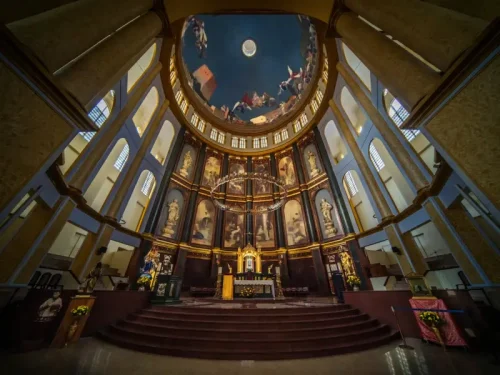
Photo of the Metropolitan Cathedral in San Salvador by Intricate Explorer on Unsplash.