Issue 323
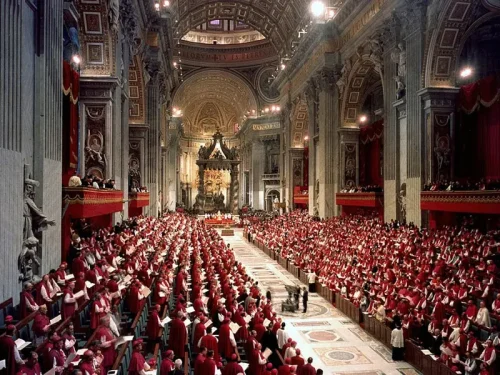
Lumen Gentium 60 years on
by Paul Milarvie
It is sixty years since the publication of the second Vatican Council’s document on the Church, Lumen Gentium, which proclaims Christ as the light of humanity. It was the ’heartfelt desire’ of the Council that, by proclaiming the Gospel, the Church would bring that light to all peoples. Today we live in a very changed and challenging world in which the Church dares to be a credible voice of faith, fulfilling its mandate to preach the Gospel to the ends of the earth.
In these sixty years we have witnessed four papacies, all with their distinctive characteristics and tone, which have often been determined by their first encyclicals: Paul VI’s Ecclesiam Suam [1964]; John Paul II’s Redemptor Hominis [1979]; Benedict XVI’s Deus Caritas Est [2007] and Pope Francis’ Evangelii Gaudium [2015]. The Church now stands on the threshold of a Jubilee Year, calling us to be pilgrims of hope against a backdrop that couldn’t be more different from the great Jubilee Year of 2000 when John Paul II welcomed the new millennium and called for a new evangelisation. Since then, we have seen the terrorist attacks of 9/11 in 2001, the credit crunch of 2008, the global pandemic of 2020, the outbreak of war in different parts of the world and the displacement of millions of people. The development of the Internet and the so-called attraction of the global village have also changed the landscape of faith. What are the challenges for the Church today?
The map of faith
There are several contours on the map of faith that the Church must reflect on. It must be aware that it is truly global, but it has very specific challenges in different continents and countries. The map of faith since 1964 has changed. As the Church emerged from the global pandemic, it became clear that this was the biggest paradigm shift that it has had to face in recent times. The extraordinary and inspiring ‘Urbi et Orbi’ address given by Pope Francis in March 2020 offered many people a sense of light in a time of unprecedented darkness.
Today the Church must continue to look for creative and engaging ways of bringing people of faith to the church in a credible, coherent and intelligent way. One challenge seems to be that we have a language of faith that lacks any attempt to engage in a conversation in the marketplace or the public square. The term ‘global village’ is often used. A village is a meeting place for people who gather around a square, perhaps even a church, where people are known by name, where they are from and who they are related to. In contrast, the global village is often anonymous and virtual, with no personal or physical contact. Communication is done remotely, and does not display any of the characteristics associated with a village. This is a challenge for the Church.
Login or subscribe below to continue reading this article
Paul Milarvie is a priest of the Archdiocese of Glasgow.