Issue 323
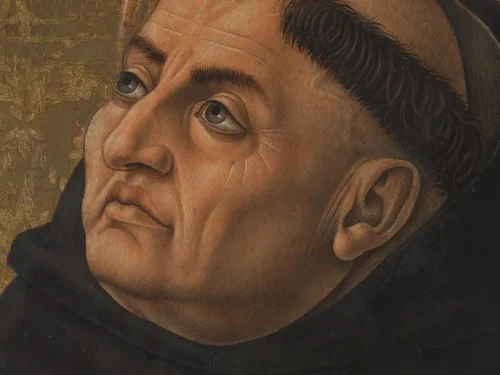
A mind for all seasons
by Jonathan Birch
Medieval Christendom produced many dazzling and difficult personalities. Thomas Aquinas was not one of them. Between Thomas and his work there is barely daylight to illuminate the man, but what evidence there is speaks of the virtues of friendship and humility (1). The Dominican friar’s enduring appeal is a triumph of substance over style, but the absence of an overbearing personality has not prevented a monomaniacal devotion to his thought which surpasses any that might be associated with Peter Abelard, Héloïse d’Argenteuil, Bernard of Clairvaux or Catherine of Sienna, and quite overshadows the man who founded the Order of Preachers (OP) where Thomas found his spiritual home, Domingo de Guzmán. He is rivalled only by Francis of Assisi.
The vital statistics of Thomas (1225-1273) have gifted the Church with three successive anniversaries to honour one of its brightest intellectual suns. The celebrations, launched by Pope Francis, began in 2023 with the 700th anniversary of Thomas’s canonisation; continued in 2024 to mark the 750th anniversary of his death; and end next year on the 800th anniversary of his birth. As we approach the triple jubilee’s climax (28 January 2025), we reflect on the life and legacy of a colossus of Christian theology and Western philosophy and consider how the ‘Angelic doctor’ can speak to us in an age divided by cultural and political conflict, in which some are nostalgic for a revival of cultural Christianity as a corrective to contemporary pluralism.
Like many men and women of learning who have left a mark on the Church, Thomas was a child of privilege, giving him access to an education which would otherwise have been dependent on the additional good fortune of patronage. Born into minor nobility, Thomas was the youngest son of the Count and Countess of Aquino, who presided over the family estate, a hilltop castle in Roccasecca. His formative schooling was at the illustrious Benedictine monastery at Monte Cassino. The school was steeped in the spirituality of its founder, but if you were ambitious for your son in thirteenth-century Europe, Monte Cassino had the allure of Fettes or Eton in modern Britain. Thomas was seemingly destined for high ecclesiastical office, but having enrolled at the studium generale in Naples, the teenage oblate found a calling which would have profound personal implications and change the intellectual history of the Western Church.
Becoming a Dominican
It was in Naples that Thomas encountered the Dominicans, a mendicant order only formally recognised by the papacy in 1216. As a religious order with an emphasis on preaching and teaching, they eschewed the economic security that monastic communities enjoyed. This was not the life Thomas’s parents had planned for and invested in. On hearing he had taken the habit in the spring of 1244, his mother Theodora set out for Naples to confront her son and bring him to his senses. In a dramatic intervention designed to save Thomas from himself and the raggamuffin brothers of his choice, his parents authorised an operation to capture him, a seizure which included at least one of his (biological) brothers of necessity. He was confined in a second family home in Montesangiovanni and later Roccasecca.
Login or subscribe below to continue reading this article
Dr Jonathan C P Birch lectures in Theology and Religious Studies at the University of Glasgow.
Notes:
(1)The best recent study for a general audience is Denys Turner, Thomas Aquinas: A Portrait (New Haven: Yale University Press), 2013.
(2)Compare Turner, Thomas Aquinas, p. 12, with the monumental Jean-Pierre Torrell, St. Thomas Aquinas: Vol. 1: His Person and Work, Robert Roral (trans.), Washington DC: The Catholic University of American Press, p. 10.
(3)Torrell, Aquinas, p. 11.
(4)His reported description to his amnesia, quoted in Turner, p. 53.
(5)Bernard McGinn, Thomas Aquinas’s Summa Theologiae: A Biography (New Jersey: Princeton University Press, 2014) p. 153.