Issue 326
Music for Lent and Passiontide
by Paul Matheson
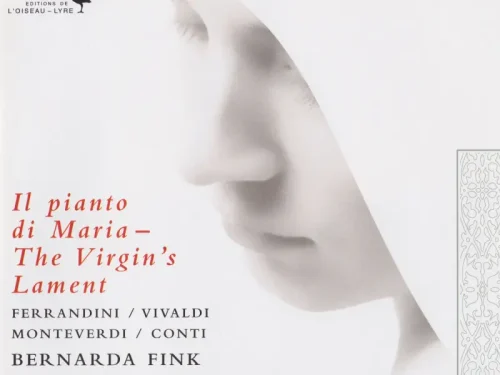
Il Pianto di Maria - The Virgin's Lament – Ferrandini /Vivaldi /Monteverdi /Conti, performed by Bernarda Fink and Il Giardino Armonico (Decca: 4781466). The penitential reflection and spiritual preparation of the season of Lent can be greatly supported and enhanced by the large volume of sacred music that ponders deeply the Passion of Jesus, the Sorrows of Mary, the Lenten themes of penitence and the Easter themes of redemption and the sacred mysteries.
As part of their Lenten preparation, many people pray the stations of the cross through the eyes of Mary, the Mother of Jesus.
Over the centuries numerous composers have set Marian texts, such as the ‘Stabat Mater’, to hauntingly beautiful music to help us contemplate the thoughts and emotions of Mary of Nazareth during the Passion of Jesus. To prepare for the mental and emotional challenge of imagining oneself accompanying Mary through the Stations of the Cross, listening to certain music can be very helpful. In a previous Easter issue, Open House referred readers to ‘Good Friday Eastern Sacred Songs’ by the Lebanese singer Fairuz. Equally compelling is the CD recording ‘Il Pianto di Maria - The Virgin’s Lament’ (Decca: 4781466), an elegant, harmonious collection of baroque compositions for Holy Week, performed by the famous Argentinian mezzo-soprano Bernarda Fink and the celebrated Baroque orchestra Il Giardino Armonico.
The collection contains two vocal pieces that view the Passion of Jesus through the eyes of his mother Mary. The first is the sacred cantata ‘Il Pianto di Maria’ (‘The Tears of Mary’) composed by Venetian composer Giovanni Battista Ferrandini (1710-1791). Regarded as a masterpiece of baroque sacred music, ‘Il Pianto di Maria’ was long presumed to have been composed by G.F. Handel, but in the 1990s experts established it as the work of Ferrandini. Ferrandini was a musical child prodigy who went to Bavaria as a teenager to work as a musician and composer in the Munich court. Ferrandini was well-regarded as a prolific composer of operas, and he also composed sacred cantatas for solo voice and instruments. In 1755 he moved to Padua where he was visited by the young Wolfgang Amadeus Mozart in 1771. The second Marian piece is ‘Pianto della Madonna’ (‘Tears of the Madonna’) by Claudio Monteverdi (1567-1643). Monteverdi uses solo mezzo-soprano voice, accompanied by viola da gamba and lute, to present Mary speaking to her Son and asking to share his suffering and his death.
The third vocal piece in this collection is an aria from an oratorio about the martyr Saint Lorenzo, composed by Francesco Conti (1682-1732), composer to the Habsburg court ofVienna. It has an association with Holy Week because it presents an example of how the Passion of Christ was imitated in the martyrdom of saints. This composition features a seldom-heard ancestor of the modern clarinet - the soprano chalumeau, which was used to accompany songs of pathos in baroque music. The remaining instrumental pieces on this CD (by Vivaldi and others) also have a connection to Holy Week.
I would like to focus particularly on Giovanni Battista Ferrandini’s composition ‘Il Pianto diMaria’ (‘The Tears of Mary’) because, as the longest piece on this disc (over 25 minutes), it isthe musical listening experience that comes closest to praying the Stations of the Cross through the eyes of Mary of Nazareth. Ferrandini subtitled his composition ‘Cantata sacra da cantarsi dinanzi al Santo Sepolcro’ (‘A sacred cantata to be sung before the Holy Sepulchre’). The sacred cantata opens with a suspenseful, brooding exposition, sung in recitative by Bernarda Fink’s superbly expressive mezzo-soprano vocal, with sensitive, atmospheric accompaniment (on harpsichord, cello, lute, viola da gamba) which underscores the brooding sense of impending catastrophe:
‘When the fatal hour prescribed by heaven arrived,
when to Calvary mountain,
its deathly stage prepared,
the Creator’s Son was to walk;
there too, dressed in mourning,
was seen the Mother in desolation, witnessing
the dreadful tragedy, and - ah heavens! -
motionless in her grief; only alive
that she might feel the bitter immensity of his torment.
And, while she melts into tears,
thus, amid her sobs, she said’.
Having captured our rapt attention with the gripping opening recitative, the cantata then escalates its emotional impact by switching to a ‘cavatina’ to express the words then spoken by Mary of Nazareth. The mezzo-soprano vocal is now joined by the full baroque orchestra of (violins, violas, cellos, etc.). ‘Cavatina’ is Italian for ‘little song’ and in classical music it means a simple, song-like aria. Here it is used to express all the love and all the pain in Mary’s heart, expressed in sweet, slow, measured, melodic, melancholic phrases of heartbreaking beauty. Bernarda Fink sings the part of Mary with a powerfully affecting vocal delivery that is somehow both fervent and restrained at the same time, conveying to the listener a palpable sense of Mary trying to hold back an endless ocean of love and grief:
‘If I was made the Mother of God
only to see God die,
Forgive me, Eternal Father,
Your grace is a heavy martyrdom’.
The cantata then switches back to the recitative musical narrative style, and the full baroque orchestra continues to accompany the vocalist, using dramatic, percussive strings to evoke the terrible events being witnessed by Mary: the scourges, the thorns, the nails. For us as listeners, it is the musical equivalent of the penitential processions of the confraternities in Sorrento and Seville during Holy Thursday and Good Friday, displaying to us the instruments and stages of Christ’s torture and torment:
‘Ah, unhappy me! Alas!
My divine Son,
by a disciple betrayed,
by another still denied,
by the most faithful abandoned,
by an unjust court
condemned as a criminal,
flayed with scourges,
torn by thorns,
pierced by nails,
crucified among thieves,
given bile to drink,
vilified by the world,
abandoned by Heaven.
Is it not enough that I must hear his beautiful Name
uttered amid the blasphemies of this barbaric crowd?’
The cantata then returns to quiet, restrained recitative, with the vocal once again lightly and sensitively accompanied by harpsichord, viola da gamba, lute. But the instrumental accompaniment falls completely silent when the anguished mezzo-soprano vocal reaches the words ‘Ei Muore! Ei Muore!’ (‘He dies! He dies!’)
Login or subscribe below to continue reading this article
Paul Matheson is a diversity officer with the police.