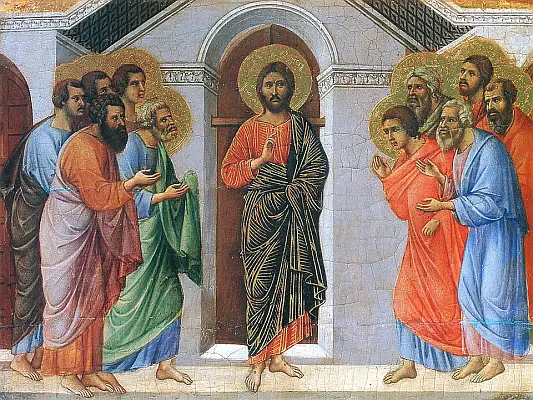
The wounded and risen Christ’s gift of peace - John 20:19-29
by Tom Magill
Locked-in
For whatever reason, Thomas had isolated himself from the other disciples. He wasn’t there when the Risen Lord appeared to them for the first time. This isolation and aloneness had opened up room for his ego and self-will – 'Unless I see … unless I touch … I will never believe.' His rational side was in over-drive: how can the impossible be possible?
He had missed out on that first encounter when Christ clothed the disciples with his peace, endowed them with the Holy Spirit, and shared with them his divine prerogative of bringing forgiveness to others. These disciples were in 'lock-in' mode, both physically and psychologically, when the Lord came through the barriers they had erected. Yes, that was out of fear of the authorities and the mob, but perhaps also out of an inchoate understanding of what would be asked of them, to be sent out just as the Father sent Christ. The room with its locked doors and barricaded windows seemed a safer, less challenging place. There they could say some prayers, reminisce, share their thoughts and feelings, and feel secure together.
Christ’s Break-Through
The crucified and Risen Lord breaks through and breaks down this false security and complacency and he does this firstly through his gift of peace. This is the peace the world can never give (John 14.27), a peace which dispels fear and is rooted in God through the gift of the Holy Spirit. It is a direct participation in the life of the Trinity, the eternal self-giving of Father, Son, and Holy Spirit. This gift of peace is the beginning of human divinisation, or theosis as it is called by the Cappadocian Fathers. Already, this is sketched out in the Beatitudes: 'Blessed are the peacemakers, for they will be called children of God' (Matthew 5:9). Paul too considers peace to be an attribute and gift of God: 'And the peace of God, which surpasses all understanding, will guard your hearts and your minds in Christ Jesus' (Philippians 4:7); 'For He Himself is our peace, who has made the two one and has torn down the dividing wall of hostility' (Ephesians 2:14).
This divinisation is a process and a becoming for both the individual and the Church, and for all humanity. When the Lord appeared a second time to the disciples the room was still locked and bolted. Even after this, the disciples, now released from the room, revert to their old way of living and decide to go fishing, as though nothing had changed. This third time the Lord comes to them, he sits and breaks bread with them, gathering them eucharistically and assuring them of his abiding presence. Perhaps it was then that they understood his words to Philip that whoever sees him sees the Father (John 14.9), that he and they dwell in each other (John 15.1-11), and that they will be truly satisfied.
Login or subscribe below to continue reading this article
Tom Magill was awarded a Doctorate of Philosophy by the University of Glasgow for his study in St Mark's Gospel. He taught Bible Studies in our Scottish seminaries and in Glasgow's Faculty of Divinity. He is a retired priest of the Diocese of Motherwell.
____________________
Image: 'Christ Appears to the Disciples Behind Closed Doors' by Duccio di Buoninsegna - on the reverse panel of The Maestà Altarpiece, Sienna Wikimedia Commons Licence