Peacebuilding in Colombia
by Mark Camburn
Peace sits at the heart of SCIAF’s work – a fundamental component of what SCIAF, and the wider Caritas family of Catholic aid agencies, promotes the world over. Put simply, there can be no integral human development without peace.
In SCIAF’s new 10-year Strategy (‘A Better World is Possible for All …’ 2026-2035), we sharpen our focus on peacebuilding, by fully adopting a triple-nexus approach to our overseas work. This allows us to situate all of our overseas work on a spectrum between humanitarian – integral human development – peacebuilding: where integral human development sits at the centre, but is not achievable or sustainable without all humanitarian needs being met, and without lasting peace for all. This new approach will ensure that we fully consider peace (and justice) issues as we design our country strategies and programmes, together with our local partners across the world. SCIAF has a long track-record of working towards peace and justice with many of our partner organisations in countries such as Cambodia, Colombia, DRC, Ethiopia, and South Sudan. This experience will feed into our ways of working as we move forward. SCIAF’s work in Colombia, a place very close to my heart, helps illustrate this approach in action.
Context
The ongoing conflict in Colombia involves illegal armed groups (including left-wing guerrilla groups and right-wing paramilitary groups) and State forces. It was born out of disputes over access to land and has evolved into a conflict centred on the control of territory, natural resources, and illicit economies. In 2016 the main guerrilla group, FARC, signed a peace agreement with the Colombian government, and laid down their arms. However, the conflict did not end. Other armed groups filled the void - some that already existed, such as the ELN, and new groups. Now largely a rural conflict, it continues to impact on rural communities, who find themselves caught in the crossfire, particularly in areas such as Chocó, where SCIAF works. Lives continue to be lost, communities displaced, community leaders and their families threatened, women and girls continue to be subjected to conflict-related sexual and gender-based violence, and children and young adults continue to be forced or coerced into the conflict.
In July 2022 the Colombian Truth Commission published a report on the impact of the ongoing conflict in Colombia. It found that there were at least 450,000 fatalities (80% civilians), caused by all actors involved in the conflict, including the State (45% paramilitary groups, 27% guerrilla groups, and 12% state agents). At least 110,000 people had been forcibly ‘disappeared’ and over 50,000 people were victims of kidnapping. More than eight million had been forced off their land since 1985. Over 30,000 children and young people had been recruited into armed groups for war, and conflict-related sexual and gender-based violence had been widespread.
It is within this context that SCIAF has worked in Colombia since the 1980s. Our work currently focusses on the north-western region of Chocó. Bordering the Pacific and Atlantic oceans, as well as Panamá to the north, this vast biodiverse and ethnically diverse region is one of Colombia’s poorest areas. It has been continually affected by conflict for at least the last 30 years and is largely forgotten by the Colombian State, with poor infrastructure and limited access to health care, education, and employment. Its population is predominantly Afro-Colombian and Indigenous, and many live within nationally recognised autonomous territories, although they do not enjoy full access or use of their territories as a result of the conflict. In addition, the region holds vast mineral and natural wealth with gold deposits, copper and timber and is suited to both the cultivation of coca leaves, and the production of cocaine. As such, illicit activities such as illegal gold mining, and trafficking – drugs, arms, people - are rife. Within this context, the work of peacebuilding is both essential, and incredibly complex.
Locally led
For an outside organisation like SCIAF, with no physical presence in Colombia, it would be impossible to fully comprehend the complexities of conflict in Chocó. This is why the first guiding principle of all our peacebuilding work, both in Colombia and elsewhere, is that it should always be locally led. SCIAF only works through local partner organisations, who are well established in the countries and regions where we work, and who form part of the existing social fabric. Colombia is a perfect example of why this is so important. In Colombia, our main partners are church-based. We partner with our sister agency Caritas Colombia, the country’s Catholic aid agency, as well as local diocesan Caritas organisations within the Dioceses of Quibdó, Istmina-Tadó, and Apartadó. These partners, and the Catholic Church in general, have played a fundamental peacebuilding role in Colombia at a local, national, and international level. Throughout the darkest days of conflict, the church remained ever present, standing with communities, calling out atrocities, and never ceasing to call for peace and dialogue. When others, including the State, left conflict areas, the church stayed behind, never abandoning the most vulnerable. As a result, in places like Chocó, the church is seen as a beacon of hope, welcomed by all communities, and respected by armed actors. This allows local Caritas organisations to operate within the midst of the ongoing conflict, reaching communities when they are most needed. They have an unparalleled understanding of the conflict and the different actors involved, as well as an inherent understanding of what will, and won’t, work in terms of peacebuilding. We in SCIAF are led by our local partners when designing interventions that respond to local needs.
Expertise
Church-based partners are not our only partners in Colombia. Another guiding principle of our work is to ensure that we bring in key local and international expertise as required, and that all our partners can work together towards a shared goal. In Chocó, we know that issues such as displacement, access to ancestral lands, and access to natural resources, remain unresolved for many, and that these represent both the consequences of conflict, and driving forces behind continued conflict. If local communities are to achieve peace, these issues need to be dealt with. So, we partner with expert organisations who can guide communities in their efforts to secure a return to their lands, and the protection and restoration of their ancestral lands and natural resources.
This approach is highlighted by our work on the Atrato River over the last 10 years. The Atrato flows through most of Chocó, with the majority of the Chocoan population living within its river basin. It is a large, fast-flowing river, which is central to the ways of life and culture, of the Afro-Colombian and Indigenous population. It provides their food, transport, and recreation, and is the inspiration behind many of their songs and poems. Yet it is being destroyed, and their way of life with it, through illegal gold mining, and the ongoing conflict. In the mid-2010s we began working with an expert local lawyers’ organisation, Siembra, who worked with the church and local communities to enable them to present a legal case for the rights of the river, and the riverine communities who depend on it. We also reached out to international experts (including UK academia and international advocacy partners) to support and strengthen the process. As a result, the River Atrato was recognised by the Colombian constitutional court as a legal person, a bearer of rights, and the State was mandated to protect, conserve, restore, and maintain the river and its communities. This was a ground-breaking ruling, and the Atrato became the third river in the world to be granted rights, and the first river in a conflict region. It is fundamental for peacebuilding in the region. Without a healthy, functional river, communities will continue to be displaced from their lands as a result of flooding, loss of livelihoods, or isolation, further fomenting the drivers of conflict in the region.
Local leadership
A third fundamental component to our peacebuilding work in Colombia, is the strengthening of local leadership – local voices which represent all the different historically marginalised groups (such as Afro-Colombian and Indigenous peoples, women, rural people, people with disabilities, youths, and the elderly), and who can represent their communities in peacebuilding processes. Through our local partners, we deliver local leadership training throughout Chocó. This training generally takes a ‘training of trainers’ approach. This multiplies their impact through replication across many communities throughout Chocó, as an effective way of both developing peacebuilding and conflict resolution skills and methodologies and fomenting peaceful coexistence across the region.
The training often brings together leaders from different communities and groups, where pre-existing tensions threaten to prolong, rather than resolve, conflict. By working together, it is possible to overcome differences and work towards a shared vision of peace. It is here, once again, where working through the local church is so effective, given its commitment to peace through dialogue, and its natural role as mediators. In Chocó, through the tireless work of the church, together with community leaders, we now see effective regional peace platforms emerge, with representation from across the many different historically marginalised groups in the region. In addition, we have seen community leaders become spokespeople for the river Atrato, fighting for, and securing, their role as Guardians of the Atrato, and speaking for the river with the State and other key stakeholders. We have also seen many local leaders play key roles in the peace processes between the State and the illegal armed groups, ensuring that the voices of those most affected by the conflict are heard, and not forgotten.
Children and young people
A fourth, and final, key component of our peacebuilding work in Colombia, is engaging with youths. Young people in Chocó are at risk of forced recruitment into armed groups. Due to the limited education, employment, and recreation opportunities, particularly in rural Chocó, they are also at risk of being drawn into the illicit economies that are rife in the region, feeding into a seemingly never-ending cycle of conflict. Through our local partners, SCIAF focusses on peacebuilding and conflict resolution skills amongst children and young people. We do this through sport, music, drama, and arts and crafts. Our specialist partner Fundación Buen Punto delivers bespoke Rugby4Peace and SurfTherapy sessions with at-risk-youths across the region, and our church-based partners work with schools and youth groups to deliver their own ‘Peacebuilding Pedagogy’. These approaches aim to equip young girls and boys with the skills and tools to resolve conflicts peacefully, as well teaching them about peaceful coexistence, and providing them with positive alternative role models. Perhaps just as importantly, they provide safe spaces where children and young people can play and learn together – an oasis of normality within a context of ongoing conflict.
Our work in Colombia gives a taste of how SCIAF approaches peacebuilding. Whilst programmes may look different from one country to the next, the key components of being locally led, developing local leadership, working with youths, and bringing in key expertise to work together with local organisations to tackle the main injustices driving conflict, can be found across all our peacebuilding programmes. It also highlights the incredibly important role of the church as a peacemaker, a role that is not unique to Colombia. At a time of great uncertainty throughout the world, with new conflicts emerging, peace agreements fragmenting and old conflicts resurfacing, the peacebuilding work of the church has never been more important.
Mark Camburn is SCIAF’s Director of Integrated Human Development
____________________
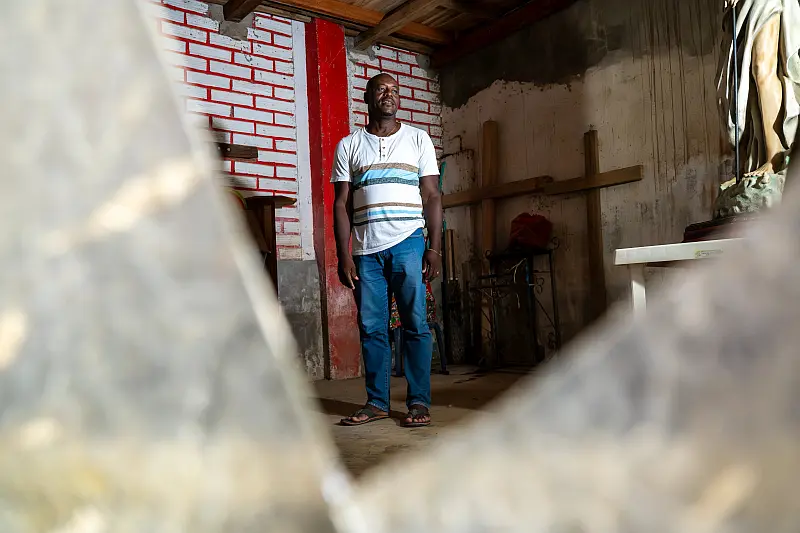
Photo of Claretian Brother Marcial who brokers peace between communities and armed groups in Chocó, courtesy of SCIAF.