The church in today’s world
by Tom Magill
In his book, The Afternoon of Christianity. The Courage to Change, Thomas Halik notes that Vatican II’s effort ‘to reconcile the Church with modernity came too late, and paradoxically it came at a moment when modernity was already on its way out’. This article aims to reflect further on this statement.
Pre-modernity characterised the Church from the 11th century right through to the Vatican Council. Its central idea was ‘Christendom’ in which the structures, institutions, and culture of civilization were supposed to reflect the Christian understanding and nature of society. Its aim was to bring the whole of humanity under the law of Christ. Rattled by the French Revolution and the Enlightenment, the Church took an oppositional stance to the new world which was emerging with its exaltation of reason, suspicion of authority, and focus on the individual conscience and popular sovereignty. Especially in what has been called the ‘long 19th century’ (through to the 1960s), the institutional Church attempted to maintain this overarching and monopolising narrative through a ghetto Catholicism, an antipathy to ‘liberalism,’ and a focus on self-preservation. This latter led to unacceptable accommodations with authoritarian states.
The Enlightenment project which characterised modernity was no less monopolising in the narrative it offered. Indeed, it can be argued that it mirrored the Church in its own ideological and totalising attitudes. Secularisation with its presumption that religion would gradually but inevitably disappear was at the heart of the project. Clearly, this did not happen but secular humanism did succeed, certainly in the developed world, in becoming the dominant ideology, replacing many of the cultural and social roles of the pre-modern Church.
Login or subscribe below to continue reading this article
Dr Tom Magill is a retired priest of the Diocese of Motherwell.
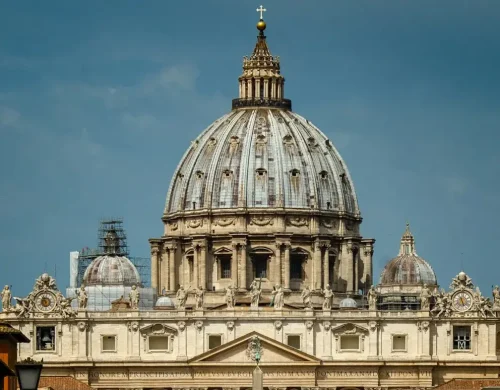
Photo by Jeff Ackley on Unsplash