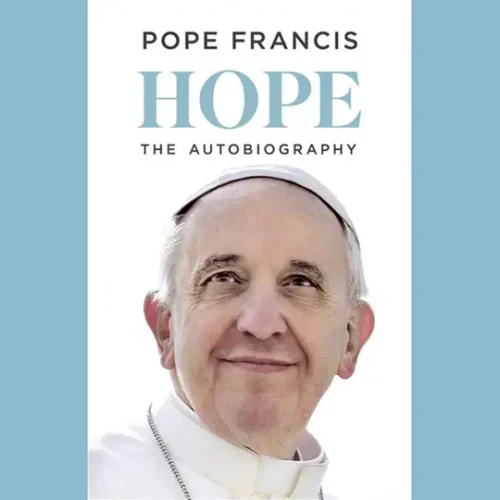
Hope
by Mary Cullen
Pope Francis, Hope. Translated by Richard Dixon, Viking, 2025.
As I write, Pope Francis is gravely ill. His autobiography, Hope, was intended to appear after his death but was published in time for the Church’s Jubilee Year of Hope, when ‘all the faithful who wish to do so can make a pilgrimage to the Holy Door of St. Peter’s Basilica in the Vatican’.
The timing of the publication seems apt: the church of Pope Francis is one of holy doors and indulgences as well as synodality, tradition as well as reform, a church which both limits and expands the contribution of women. The autobiography, almost 300 pages long, sheds light on some of the tensions Francis has held together in the church during his papacy. It invites us into the world of Jorge Mario Bergoglio, born the son of Italian immigrants in Buenos Aires in December 1936, the oldest of five children, who became a Jesuit priest, bishop and pope. It is a fascinating book, at once deeply spiritual and down to earth, wise and sharp-eyed.
Family life
He writes extensively about his family life and draws many lessons from it. The first chapter opens with the sinking of the SS Principessa Mafaldi which set sail from Genoa on 11 October 1927, bound for Buenos Aires. Francis’ grandparents and their only son were supposed to have been on board but couldn’t sell their possessions in time. They sailed 16 months later, during one of the coldest winters of the century, his grandmother with everything of value sewn into the lining of her coat. They were one of many thousands of migrant families seeking a new life. This was one of the reasons, Francis tells us, that his first papal journey outside the Vatican was to Lampedusa, the tiny Mediterranean island that has become a byword for ‘the contradictions and tragedy of migration’. Together with war, about which he learned much from his grandfather’s experience, and the impact of the climate crisis on the world’s poorest people, it was to become a central theme of his teaching: ‘Emigration and war are two sides of a single coin’ (p.15).
From his family he also learned the importance of gratitude and thankfulness, from which stem ‘respect for human dignity and social justice’. To say please, he says, is a request to enter with kindness into the life of others, a mark of respect to them as individuals. This was the meaning of his buonasera (good evening) to the people who gathered in St Peter’s Square on his election of pope. ‘I gave that greeting because that small word that we hardly notice is a declaration of our care, our attention, and in the end, our love for one another’ (p. 49).
We learn of his love for music, film and literature, which began in his family. He recalls his years as Jesuit superior in Argentina during military dictatorship when thousands of people were tortured, murdered and ‘disappeared’. He writes movingly of those he encountered and those he tried to help during those ‘terrible years’. He gives an interesting behind the scenes account of his election as pope.
Login or subscribe below to continue reading this article
Dr Mary Cullen is editor of Open House.