Issue 324
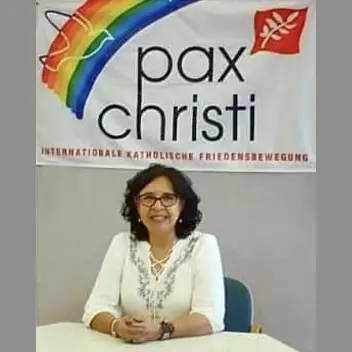
Global peacemaker
by Marian Pallister
When Martha Inés Romero was appointed Secretary General of Pax Christi International in January 2023, she said ‘I look forward to listening and learning from our dedicated members and partners worldwide. The diversity in our movement is our main strength, one that we can draw on as we transform communities through justice, peace, and nonviolence.’ We look forward to welcoming her to Scotland in March.
A native of Colombia, Martha Inés was not only steeped in issues of justice, peace and nonviolence, but of course knew all about diversity. Colombia is a country that is home to a multiplicity of ethnic origins: there are the descendants of the original native inhabitants; of Spanish and other European colonialists; of Africans brought to the country as slaves; and of 20th century immigrants from Europe and the Middle East. The range of cultural heritages is as exciting as it is far reaching.
No great surprise, then, that this is a woman with a genuine desire to listen to and learn from members of this peace organisation that has its roots in a Europe emerging from the tragedies of World War II and that continues to grow and flower around the world.
Origins
Pax Christi International sprang to life in a flat in Montauban, a town in southern France 50 kilometres north of Toulouse, on March 13, 1945. The south of France had already been liberated from the Nazis and another Martha – Marthe Dortel-Claudet – co-founded with Pierre Marie Théas, Bishop of Montauban this Catholic organisation seeking reconciliation and peace. They called it Pax Christi, the Peace of Christ.
In the intervening 80 years Pax Christi became Pax Christi International, adding organisations to its membership worldwide. Having been part of the UK organisation for many years, a growing conviction that those of us north of the border had something different to offer led to Pax Christi Scotland being accepted as a member organisation in 2019 – just in time to launch into the pandemic.
While that seemed a negative at the time, the Pax Christi community around the world quickly accepted that online meetings were the way to go. For Scottish members, scattered from the Outer Isles and Northern Isles to the Borders and Dumfries and Galloway, online has proved to be a bonus – and in international terms, it gave us the opportunity to meet with global peacemakers and to get to know Martha Inés Romero.
At the time of her appointment, Pax Christi Scotland had been holding meetings with Police Scotland, which had contracted to train Colombia police officers - who were then regarded as some of the most violent in the world. With Justice for Colombia, we made the case that this was not appropriate, and when the then chief of Police Scotland admitted in his retiral speech that the Scottish force was itself racist and sexist, the contract was ended. For Pax Christi Scotland this confirmed that our voice was being heard – and it also created an affinity with Colombia as it moved forward under a new president.
And so, we warmly welcomed the appointment of this new Secretary General who had not only lived through that previous brutal regime but had been instrumental in promoting a nonviolent society in her country for many years.
Journey
Based in her native Colombia, Martha Inés had served Pax Christi International for over 15 years when she was appointed Secretary General. She had already served on the international board, and she has continued to act as regional coordinator for Latin America and the Caribbean while taking on the considerable duties of Secretary General.
But what has been Martha Inés’s peacemaking journey?
She had studied conflict transformation at the Kroc Institute for International Peace Studies - part of the University of Notre Dame in the US state of Indiana. The Institute, founded in 1986, was inspired by the vision of a world free from the threat of nuclear holocaust held by Fr Theodore M. Hesburgh, C.S.C., and the philanthropist Joan B. Kroc. During his 35 years as president of Notre Dame, Fr Hesburgh was a leading national voice for civil and human rights and the abolition of nuclear weapons. Joan Kroc was equally concerned about the nuclear arms race and was committed to world peace.
For Martha Inés, the Kroc Institute was a valuable step on her own journey seeking peace and justice and addressing the causes of violent conflict. She calls herself a ‘humble life-long learner,’ and on her continued quest for peace, justice and nonviolence, she has enthusiastically and effectively shared the vast experience she has acquired working throughout the Americas and with global partners. She was a member of the Catholic Peacebuilding Network; has contributed to the transformation of Catholic social teaching through promoting a culture of peace, nonviolence, and reconciliation, first with Catholic Relief Services, contributing to the Caritas Internationalis network, and then with Pax Christi International; and through her valuable participation in synodal processes and the Laudato Si’ Action Platform.
When Martha Inés accepted Pax Christi Scotland’s invitation to share time with us in person, it was a given that we would visit Faslane. We are one of those nations that unwillingly hosts nuclear weapons, and we have shared with Pax Christi International the outspoken statements against weapons of mass destruction that the Scottish Catholic Bishops Conference has been making since the 1980s.
On Ash Wednesday, we will join the annual vigil at Faslane organised by Glasgow Catholic Worker.
Her peace interests are wide, however, and it was knowing that Martha Inés is involved in ecumenism and interfaith activities that inspired us to include an invitation to deliver the keynote speech at the Scottish Bishops’ Interreligious Dialogue Committee Annual symposium. This reflects her work with partners across the civil society for dialogue and cooperation within communities across Latin America and the Caribbean, as well as her promotion of interfaith activities through the international movement.
At the heart of all Martha Inés’s work is always an emphasis on nonviolence, as there is for Pax Christi organisations around the world. Pax Christi International’s Catholic Institute for Nonviolence is a major focus of her work, undoubtedly fed by her deep involvement in Latin America and the Caribbean in concerns such as those adversely affected by mineral and fossil fuel mining, in land issues, injustices directed at women and at indigenous peoples. She has said ‘There is already extensive knowledge, research, and experience on nonviolence. The institute seeks to enhance this body of work and make it more accessible to the Church.’
Pax Christi Scotland’s monthly exploration with Glasgow University’s Anna Blackman of Advancing Nonviolence and a Just Peace In The Church and the World, edited by Rose Marie Berger, Ken Butigan, Judy Coode and Marie Dennis is our contribution to the Institute’s work.
We have, of course, set aside time to share our current work and our future plans with Martha Inés, but we have also tried to reflect her wide-ranging interests in our programme. She has experience in the aid sector, for example, holding international roles at OXFAM Great Britain and the Catholic Relief Services. She will therefore be very much at home teaming up with SCIAF, Justice and Peace Scotland and Justice For Columbia for our conference with Catholic school children at the Scottish Parliament.
The full programme is shared here, and we hope you will join us as we offer Martha Inés a snapshot of Scotland’s pathway to peace.
Pax Christi Scotland’s programme with Martha Inés Romero, Pax Christi International’s General Secretary:
Monday March 3rd Martha Inés will speak at Glasgow University on the importance of Peace Education and Adult Faith Formation, followed by a Q and A.
Tuesday March 4th Martha Inés will deliver the Time for Reflection at the Scottish Parliament.
Wednesday March 5th Martha Inés will attend the annual Ash Wednesday peace vigil at Faslane Nuclear Base.
Thursday March 6th Martha Inés will deliver the keynote speech at the Scottish Parliament at a conference for Catholic secondary school pupils on Pax Christi Peacebuilding on Colombia (part of the Colombia focus of this year’s SCIAF Lenten campaign). The event is supported by Pax Christi, SCIAF, The Scottish Catholic Bishops’ Justice and Peace Commission, and Justice for Colombia Scotland.
Friday March 7th and Saturday 8th Martha Inés will deliver the keynote speech at the Scottish Bishops’ Interreligious Dialogue Committee Annual symposium and be part of discussion panels.
Sunday March 9th – Tuesday 10th Martha Inés will address the Pax Christi Scotland Gathering and Retreat at the Conforti Centre In Coatbridge, along with other speakers. A time for Reflection, Prayer, and Eucharist to explore the spirituality of Catholic Peacemaking in the 21st Century.
The Pax Christi Scotland retreat is subsidised by the Xaverians and Pax Christi Scotland and we would be grateful if members wishing to attend could contact anna.sweeney@xavs.org by February 7th when it will also be advertised to non-members.
Marian Pallister is chair of Pax Christi Scotland
Photo: Martha Inés Romero