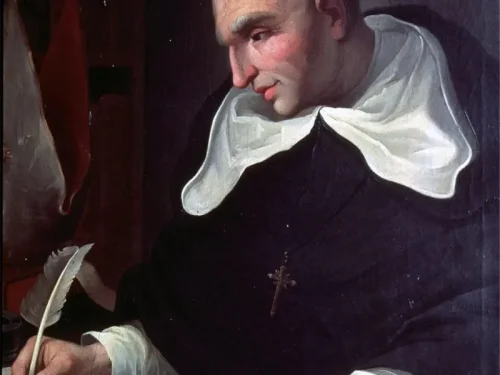
Human rights in the Dominican tradition
by Duncan MacLaren
The concept of mercy is of particular importance to Pope Francis. Ten years ago he proclaimed an Extraordinary Jubilee of Mercy:
‘The Church is called above all to be a credible witness to mercy, professing it and living it as the core of the revelation of Jesus Christ. From the heart of the Trinity, from the depths of the mystery of God, the great river of mercy wells up and overflows unceasingly. It is a spring that will never run dry, no matter how many people draw from it. Every time someone is in need, he or she can approach it, because the mercy of God never ends. The profundity of the mystery surrounding it is as inexhaustible as the richness which springs up from it’ (Para 25, Misericordiae Vultus).
At my first meeting of the International Dominican Justice and Peace Commission, I was astonished at reports from friars and sisters in Europe, North America and Australasia – the so-called Global North – that many young Dominicans thought justice and peace old hat and devoid of spirituality. It was different in Africa, parts of Asia and Latin America where the huge sufferings of humankind were not so easily discarded.
I believe that justice and peace are central to the Gospel and to the Dominican charism of preaching it; and that human rights are at the centre of justice and peace work. This is one of the main legacies of the Dominican Order in today’s world.
Justice and Peace
As Catholics, we must be concerned about the world in which people suffer from injustices. As Timothy Radcliffe OP said in Vowed to Mission (1994), ‘you get a different view of the world depending if you’re looking at it from the seat of a Mercedes or the seat of a bicycle’. We must look at the world through the eyes of the poor and oppressed.
The first principle of Catholic Social Teaching is human dignity – we are created in the divine image. Dignity is inherent to our humanity. This is stated in UN’s Universal Declaration of Human Rights (without the God talk); but in practice there is a difference between the secular and Catholic view. The Catholic worldview is that these rights are innate whereas in the secular world they are granted.
The secular approach is based on the arguments of the social contract theorists – people like Thomas Hobbes and John Locke. For them, society is perceived as contractual in nature and a person is understood as an autonomous individual with rights to protect his or her autonomy. The Catholic view stems from natural law which regards the individual as having multiple duties, given that the person is radically social by nature, and enters life with various bonds, ties and obligations. The kind of society stemming from this view is less contractual in nature, more organic and we have responsibilities to others.
According to the theologian Linda Hogan, ‘[t]he main components of the Catholic human rights tradition revolve around the centrality of the human person, [using] human rights as ways to safeguard human dignity in the social context, [incorporating] the correlation of rights and duties, the harmonisation of rights under the common good and the principle of subsidiarity’ (1).
Login or subscribe below to continue reading this article