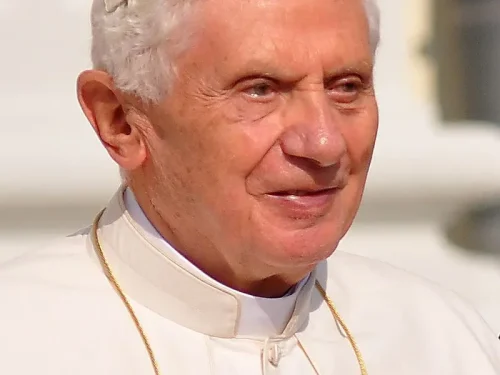
Benedict’s Legacy
by Werner Jeanrond
The death and burial of Pope Benedict XVI (1927-2022) marks the end of an era that includes the pontificate of his predecessor John Paul II. Their common desire and fight for a united and purified Roman Catholic Church died with Benedict. It was, alas, a Church that never really existed.
A number of Catholics have been sharing Benedict’s longing for a uniform, hierarchical, patriarchal and monarchic Church with a clearly defined doctrine as a stark alternative to the pluralist, secular and gender sensitive Western world. When Benedict resigned from his Petrine office in 2013, it became obvious that he had not been successful in governing the Church in accordance with his own theological parameters. He was, however, widely praised for his courageous step to retire and thus to allow a successor to tackle the ever-increasing challenges of the Church in today’s pluralist and globalising world.
Since Benedict remained convinced that the Church was where the priests are, his clericalist approach to discipleship run into two devastating problems: first, in most countries, the number of priests is rapidly decreasing, and hence the bishops can no longer deliver the sacramental life which they have been obliging the laity to observe. Second, the unfolding of the shocking clerical abuse crisis in the Church destroyed any image of a caring Church.
The continuation of the Church’s structures was deemed to be more important than the restoration and healing of the victims of abuse. Although as cardinal and as pope, Benedict sharpened the laws of the Church against clerical sexual misuse, the actual victims were never granted prominence in a Church that, at the same time, pretends to follow Jesus Christ to the margins of society.
Login or subscribe below to continue reading this article
Werner G. Jeanrond is Professor Emeritus of Systematic Theology in the University of Oslo. He was Professor of Divinity at the University of Glasgow from 2008-2012