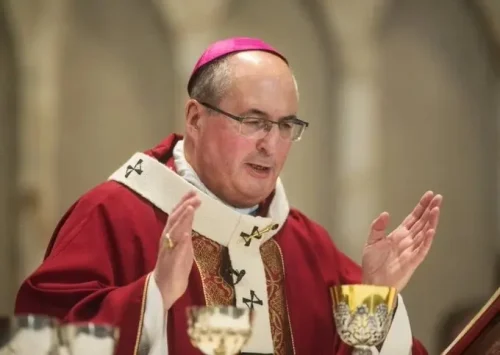
Archbishop Philip Tartaglia (1951-2021)
by Mary Cullen
Archbishop Philip Tartaglia died on 13th January, the feast of St Mungo, patron saint of Glasgow. He was 70 years old and had tested positive for Covid-19.
He was one of nine children born into a Scots-Italian family who owned and ran a fish and chicken shop on Alexandra Parade in Dennistoun, in the east end of the city. He will be remembered by many for his compassionate response to the city’s tragedies - the helicopter crash at the Clutha Bar in 2013 and the bin lorry crash in George Square just before Christmas, 2014. He wept openly with survivors and the bereaved. He also spoke out strongly against the forced eviction of asylum seekers in 2019, saying it brought indignity and suffering to the refugees and dismay to the citizens of Glasgow. He appealed to the Home Secretary, Priti Patel, to provide decent accommodation for them in accordance with their dignity and human rights.
Philip Tartaglia was ordained a priest in 1975 after attending the national junior seminary at St Vincent’s, Langbank, St Mary’s at Blairs in Aberdeen, and the Scots College in Rome. He completed a doctorate in Rome in 1980 and became vice rector of the national seminary at Chesters College, Bearsden, in 1985. Two years later he was appointed rector. He served in parish ministry in Dumbarton and Duntocher before returning to Rome as rector of the Scots College in 2004. The following year he became Bishop of Paisley, and in 2012 succeeded Archbishop Mario Conti as Archbishop of Glasgow.
He was a man of the church. He was also, said Bishop Hugh Gilbert, who preached at his funeral, a shy and sensitive man who had to deal with many pressures. Among them was the growing shortage of priests. In January, 2014, Archbishop Tartaglia circulated data to parishes on mass attendance and the number of priests in the archdiocese.
The data suggested that there would be around 45 diocesan priests by 2034, and an exercise was launched to ask parishes how priests might be redeployed. Some parishes thought the wrong question was being asked: the consultation included no reference to the role of lay people or the possibility of new ways of being church.
In 2017, Archbishop Tartaglia caused a stir when he accused Scottish Catholics of becoming ‘too wishy-washy’ in standing up for their faith. In an essay for Crux magazine, he said that too many believers had submitted to ‘secular values’. When challenged by secularism, he said, many Catholics avoid saying they really believe in anything supernatural.
Archbishop Tartaglia will be remembered as a conservative churchman who led the Archdiocese of Glasgow at a time of great challenge, and as one who was more comfortable in the church than the public square. He was, said Bishop Gilbert, someone of gravitas, in whom head and heart came together, possessed of intellectual force and clarity and at the same time of great human warmth.