Issue 324
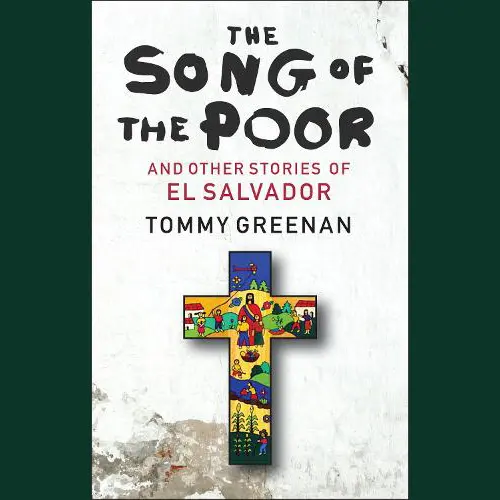
The Song of the Poor
by Duncan MacLaren
Tommy Greenan, The Song of the Poor and Other Stories of El Salvador. Darton, Longman and Todd, 2024.
Tommy Greenan was born and raised in Edinburgh’s Craigmillar, where he lived for the first few years of his life before the family moved to Meadowfield. He studied for the priesthood in the Scots College, Valladolid.
He worked among the poor of El Salvador and Guatemala among repressive regimes and extreme violence at the height of the war between the oppressive Salvadoran Government and the leftist Farabundo Martí National Liberation Front (FMLN). It is interesting to note that Tommy shared similar views to Pope Francis on the importance of the option for the poor to the faith, looked upon St Oscar Romero as a role model of a pastor and exalted Christian hope in bringing change to the lives of the marginalised.
We were reminded of this when Pope Francis opened the Holy Door of St Peter’s Basilica on Christmas Day 2024, ushering in a jubilee year for ‘Pilgrims of Hope’ in our world riven by violence and despair. The introduction to The Song of the Poor by a Latin American priest journalist states that the 92 stories that make up the book reveal ‘the real humanity of a pastor at the heart of a little town and its surrounding villages in the mountains of Chalatenango, suffering the same repression, feeling the same pain, but bringing hope’. Tommy lived as a pilgrim of hope for others.
I was able to witness this myself when the late Bishop Maurice Taylor, formerly Bishop of Galloway, and I visited Tommy in a parish in Chalatenango where Fr Henry McLaughlin was the parish priest (he writes his own fine tribute to Tommy and puts his work into context in the book). The morning after we arrived, as we got up for breakfast and a coffee, Tommy asked us to look out the window. The entrance to the church was covered with sleeping soldiers in fatigues. They had decided to bed down during the night as they sought out rebels in the area. Often, priests were apprehended or even shot. The soldiers disappeared soon after greeting Tommy – Henry was taking a break in Scotland. Tommy recounts such an encounter in the book.
I accompanied Tommy on a trek up a mountain towards noon on a hot day to the settlement of Higueral, which was populated by internally displaced people who were on the run for safety. Exhausted by the heat and exertion – after all, I was celebrating my fiftieth birthday – I told Tommy I had to lie down for an hour and would talk to the people later. SCIAF had supplied funds so that they could buy materials for shelter before they built sturdier homes, plus two mules for carrying supplies up the mountain!
Massacre
More importantly, they graphically told me about the massacre that had taken place six years before by the death squads and I was shown the graves of their friends and relatives, and wept. The killers had slaughtered babies, women and men, young and old, but told the world that they had killed ‘terrorists’. That night we celebrated my birthday with tortilla and coffee and I have never forgotten the stories of the people, their kindness and their ongoing grief at the mindless loss of loved ones. Their love for their priests was palpable, as was their love for them.
Tommy’s book is full of such stories, with the injustices suffered by the ordinary people and their bravery at its heart. His vignettes cover the death of people during the civil war, the death of infants from malnutrition during the same period, the barbarity of the soldiers against their own people as they often cut off left ears as trophies or mashed up faces or left their corpses unburied so that they would be eaten by wildlife. Always of an intellectual bent, Tommy mentions Freud, Jung, James Joyce in the same breath as Romero and various Popes and, in the story which gives its title to the volume, he defines the ‘Poor’ he lived amongst.
Tommy selects three sorts of ‘Poor’ - the Bourgeois Poor who have the mentality of the ruling power – the fourteen families who ruled the country and their allies who called the shots, literally and metaphorically, in El Salvador; the Dormant Poor who ‘take refuge in a gnostic Christ-above-humanity spirituality’ and are reluctant to denounce any violation of their rights as people created in the divine image out of fear; and the Poor with Spirit, ‘a people aware of their chains’ who ‘suffer persecution, torture and death from the military’. ‘These’, writes Tommy, ‘are the Poor who have a song to sing’.
Tommy died in his home diocese of St Andrew’s and Edinburgh at the young age of 64 in 2020. It is because he was so loved by his friends, family and fellow priests such as Fr Henry McLaughlin back living in Edinburgh that they put these scattered papers together to form this Song of the Poor. As we look towards being Pilgrims of Hope in this Jubilee Year, Tommy’s book, written with such bravery, passion and love for the people of El Salvador, deserves a place in every parish, Catholic school and places where people of good will congregate in Scotland. In the words of Pope Francis, being kind to one another out of a non-political love is not enough. ‘It is’, he states in Fratelli Tutti, ‘an equally indispensable act of love to strive to organise and structure society so that one’s neighbour will not find himself (sic) in poverty’.
That is what many of Tommy’s stories teach us. Tommy also illustrates to priests and laity alike what it is to be a priest in the most exacting of situations, what the poor still have to endure in terms of torture, extortion and murder in so many parts of the world and what we must do to make our world more just.
Dr Duncan MacLaren was Executive Director of SCIAF and Secretary General of Caritas Internationalis in the Vatican and visited El Salvador several times during and after the end of the civil war.