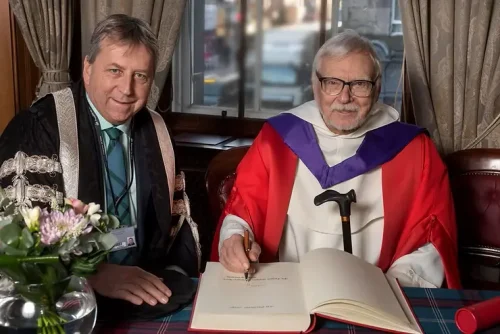
Sermon at the Requiem Mass for Fergus Kerr OP
by John O'Connor OP
Sermon preached at a requiem mass for Fergus Kerr OP, Saturday 17 January 2026 at Blackfriars Oxford
A good many years ago, I witnessed an event that some (but by no means all) of those who knew Fergus might be surprised by. In those days, before the beautiful new chapel at St Albert’s in Edinburgh was built, the Dominican community, parish and University chaplaincy used to have its Easter liturgies in the nearby St Catherine’s Convent, about 7 or 8 minutes walk away.
It was Good Friday. The priest down to preside at the 3pm Liturgy was late. Contingency plans were afoot. Then suddenly the priest turned up, at literally 1 minute to 3. When asked why he was so late, he said something along the lines of: 'I got talking to Fergus and he was very chatty. I didn’t want to go away.'
Fergus was often a very quiet man. When he occasionally got chatty, people did not want to go away because they did not want to lose the infrequent opportunity to hear Fergus in full flow; but also because Fergus could be very engaging and illuminating. The interview in the film, Becoming Dominic, gives some sense of what I mean.
Fergus was a treasure trove of recollection. He did not only remember places, events, and people; he also remembered details about people – their life stories, where they came from and what they did. This could often be recounted with humour, insight, but always really with a lack of judgmentalism and with compassion.
I remember him telling me, for example, about a big-name academic who had just published a big new book, not because of academic ideals of course - Fergus would laugh - but because he needed to pay his children’s school fees or install central heating in his house or whatever it was.
Fergus was in fact, in his own way, deeply interested in people - not in some generic way, but in a way that valued what was particular to them and their personal stories. More fundamentally, Fergus was interested in what it is to be human. None of us are abstractions. To appreciate what it is to be human, one needs to understand the particular, the fabric and feel of individual as well as collective human stories.
This is what Fergus says in an autobiographical essay in his collected essays, From Aberdeen to Oxford:
'I imagine most of the time the places and the people we see every day have, if you like, an impact that is so pervasive, so casual, so unconscious, that it would be too difficult to locate, let alone narrate. I think, for example, of washing up in the back kitchen in the novitiate house in 1956/7 with one or two of the lay brothers, their wry sense of humour, their genial and hilarious anti-clericalism actually - working alongside them perhaps shaped my life in the Order far more than the glamourous characters ever did!' (From Aberdeen to Oxford, p.xxviii)
Fergus would, I am sure, have approved of the choice of today’s Gospel reading for this occasion. Not just the second half of it, which deals with the bodily Resurrection of Christ – that’s the easier bit to explain, given how central to Fergus’ work was the importance of our corporeality. But the harrowing, even shocking, first section of the text, also brings out central themes from Fergus’ work and theological vision.
Let me explain what I am getting at, but I do so not only to speak of Fergus, but also to bring out matters of theological significance for us all. Mind you, pretty much everything I have said thus far involving Fergus can be understood as having theological significance for us all. In any case, this is what Fergus wrote in his essay, 'Charity as Friendship' – it’s a beautiful passage:
'If one’s conception of God runs… in a direction that is illuminated by the doctrine of the Incarnation, including of course a proper doctrine of the Church, after the fashion which [St] Thomas adumbrates in the tertia pars of the Summa, an entirely different perspective opens out. If God has shared his own goodness with human beings, so that this love is reciprocal, then… [we human beings] have become good: lovable, desirable, beautiful, intrinsically valuable. Each partner in the relationship loves the other for his or her character – for what the other most deeply and radically is in himself or herself. In such love neither partner is lost in or enslaved by the other. On the contrary: each loves the other precisely for the sake of his or her otherness. In such mutual respect for the separateness of each partner it is therefore at last possible for us to let God be God in the knowledge that God lets us be us.' (From Aberdeen to Oxford, p.39, italics not added)
If God lets us be us, my dear brothers and sisters, then we too should let us be us, properly understood. Part of this is doing justice to the individual stories that help shape any given person. And there are, as Fergus expressed in the passage I have just read, important theological reasons for saying this and thus for doing what Fergus himself did.
Letting us be us in our humanity, and letting God be God in his divinity, come together as one perhaps most powerfully in Christ on the Cross – with all the realness of what it is to be human, including vulnerability and death.
As Fergus appreciated and often expressed in sermons, the Creator God proclaimed by the Church is as St Paul understood, a very strange God to us conventionally-minded human beings. This is a God who reveals himself in the very depths of the wretchedness of Golgotha – of all places. As the Centurion rightly says, 'Truly this man was the Son of God'.
Before such mysteries that do not fit in with our expectations, the theologian needs to be humble, to know that even though our minds and intellects are extraordinary gifts – they are like mere foolishness before the infinite depth of the mystery of who God is.
Yet, to be intelligently aware of the limitations of all our understandings can be strangely liberating. It opens up a space in which we can explore, discuss, learn from getting it right, learn from getting it wrong, and learn from coming up with the best response we can manage. Thankfully, we believe the Church is guided by the Holy Spirit - and Fergus was a great defender of Catholic Christian doctrine. But, there is always still the need to listen attentively and openly to the varied voices and even be open to learn from the misguided. And isn’t that what St Thomas Aquinas did; and Wittgenstein did too, albeit in less obvious ways? Their openness helped Fergus write about these kindred spirits so illuminatingly.
Fergus once said in a sermon:
'To negotiate, mediate, reconcile, by making distinctions… above all by looking for what is right in what misguided and wrongheaded people say – by trying to imagine what drives them to say the things they do – it’s a tricky and perhaps even a risky way of proceeding, you can lose confidence in what you yourself believe, and, sometimes, the objections to your own views may bring you to think differently.' (From Aberdeen to Oxford, p.vii)
The reference to ‘lose confidence’ might well be autobiographical. Disagreeing was not always easy for Fergus, a man not built for confrontation. It took courage for him. But he believed and practised that 'To negotiate, mediate, reconcile… above all by looking for what is right in what misguided and wrongheaded people say' and so on, was central to the Dominican life and to the academic life too.
He could thus rejoice to see the various flowerings of Dominican academic life, as an enrichment for the Church and beyond, in the exciting, innovative, sometimes ground-breaking work of his confreres, like Herbert McCabe, Cornelius Ernst, Gareth Moore, and younger generations of friars. This theology too involves listening to and learning from even the wrongheaded, which, not least when it comes to talking about Theology, is ultimately about letting God be God and us be us.
He found that spirit in the teachers and scholars who touched him most profoundly, like Donald MacKinnon in Aberdeen, Marie-Dominique Chenu. Fergus upheld the spirit himself towards young academics cutting their teeth (to whom he gave encouragement and gentle feedback); as he did to students, as I can testify, when he was Regent 1998-2004; and as he did (at great cost to himself) when he was Prior here in Oxford for three terms, no less, 1969-1978, when he perhaps above anyone else kept the Community and its work afloat during a difficult time - for which we can all be truly grateful. He was also, I think – and I speak from personal experience - lovely to live with. There are many who miss him greatly, not only as a wonderful thinker and wise guide, but simply as a brother and a friend.
But back to letting God be God and us be us…. Standing before the throne of God, all of us are called to humility, not only regarding what we know in a way that the best theologians understand, but also humility about who and what we are. Before God, all our achievements including our good deeds and our great accomplishments, are in a sense merely human achievements, though wonderful in themselves because God allows us to be truly us.
No matter who and what we are, and especially in and after our deaths, we all rely on the grace and purifying mercy of God. In letting (as it were) God be God, we should also understand that this is the very same God who is at the same time fully love, fully wisdom, fully mercy, who is closer to ourselves than we ourselves are, who knows of what we are made and who knows the deepest recesses of our hearts.
Even as we give thanks for Fergus, rejoice in what he has given us, and tell stories about him, we nonetheless leave him with faith, hope, and love in the tender and purifying hands of the living and loving God who created Fergus and all of us too – and who loves us all from all eternity.
Eternal rest grant unto him, O Lord, and let perpetual light shine upon him, may he rest in peace. Amen.
Rev Dr John D. O'Connor OP is Regent of Blackfriars Oxford
____________________
Photograph courtesy of St Albert's Catholic Chaplaincy, Edinburgh: Professor Peter Mathieson and Fr Fergus Kerr OP