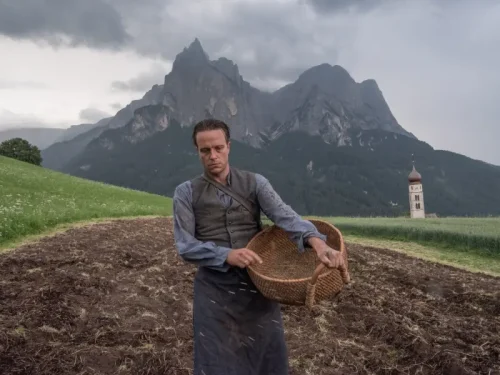
A Hidden Life (2020)
by Norman Barry
Open House readers will know the story of Franz Jägerstätter, the Austrian farmer who refused to be conscripted into the Nazi military and was beheaded. He was beatified by the German Pope Benedict XVI in 2007.
Not so many will know the background of the visionary director Terrence Malick. A Hidden Life describes the life and death of Jägerstätter. Malick was a professor of philosophy at the Massachusetts Institute of Technology and a translator of Heidegger before he switched to films. He knows therefore of what he speaks. And he takes almost three hours to tell the tale.
Jägerstätter was happily married with three small children. He never suspected the Nazi tentacles would extend to his mountain village. Notoriously he was not supported by his parish priest who was personally sympathetic. An interview with the bishop was even more disappointing since he intoned the necessity of submitting to lawful authority. He is ostracised by the other villagers.
Jägerstätter was, of course, not entirely alone. A priest he knew had been executed for refusing the Hitler oath. There was German resistance to the Nazi party. But conscientious objectors were few and far between in the conformity that made Nazism possible. Many excuses have been made mainly pinning the blame on the leaders. The populace just went along with it. For evil to prevail it is enough that good people do nothing.
This won’t do. In the UK we are currently reviewing the witness of conscientious objection in the First World War when relatively few resisted what is now seen as a battle of empires. The churches offered no support. More disconcerting for Open House readers currently is the failure of church leaders in the question of paedophilia. Where bishops fail to speak out what is the ordinary person to do?
In the film Jägerstätter can’t explain his own feelings of revulsion at Nazi evil. He didn’t argue with his inquisitors. Not many of us find ourselves on the horn of that dilemma. But our church is entering into a time and place where prelates and priests will not be around to answer questions of good and evil.
Then it is that the faith, hope and charity of the Jägerstätters of our society need to be attended to. The film was written by Malick from letters between Franz and his wife. It received at the Cannes Film Festival the Francois Chalais Prize which is awarded for good writing. It raises questions that are not dealt with often enough in films. It may be difficult to find it in a UK cinema. This tells much about the state of the industry here.
[/swpm_protected]