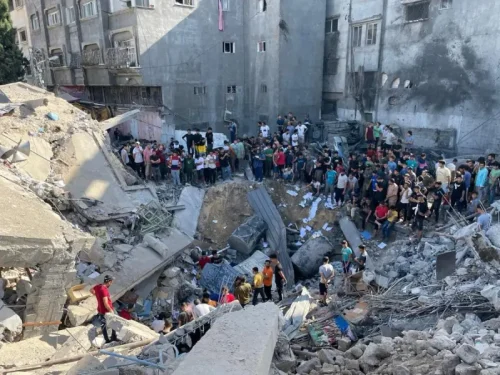
Two tragedies, 30 years apart
by Ben Wilson
This year for SCIAF, the season of Lent is dominated not by one, but two campaigns.
Our main Lenten appeal focuses on Rwanda, marking 30 years since the genocide there. SCIAF works in Rwanda with local church agencies and communities which are still scarred by the impacts of that conflict, helping communities build better livelihoods for themselves and their families. Our particular focus is on the work we do with the Rwandan Justice and Peace Commission (CEJP Rwanda) to support women and girls recovering from sexual violence.
Yet whilst we are taking this appeal for Rwanda out across the country to our supporters, schools and parishes, the current situation in Gaza is never far from anyone’s mind. Thousands of children have already lost their lives there since 7 October, and many more have had their lives torn apart. SCIAF has received generous donations of around £100k already for the people of Gaza, which is currently being spent by Caritas Jerusalem and other local partners on urgent humanitarian relief, including food and healthcare. However, the reality is that it is incredibly difficult for our partners on the ground to spend the aid.
The level of aid entering Gaza is significantly less than it was before 7 October. Our partner staff are working hard every day to serve those in need, while trying to keep themselves and their families alive, fed and warm. SCIAF has focused on raising our voice politically. It is only with a robust ceasefire that aid in any decent quantity can get in, and efforts to build a strong and lasting peace can begin to grow.
In some ways, what happened in Rwanda 30 years ago feels fundamentally different to what is happening today in Gaza. But in other ways, these two conflicts are deeply intertwined. Both conflicts reflect the same tragic human propensity for violence. Both show what can happen when hatred is allowed to fester and become entrenched. Both can be shown to have their roots in a colonial hegemony which has dominated human history and is incompatible with the conditions of universal human flourishing.
Rwandan genocide
In 1994 in Rwanda, over a span of just 100 days, an estimated 800,000 people, predominantly from the Tutsi ethnic group, were brutally massacred by extremist Hutu militias. Since the late 19th century, Rwanda had endured European colonisation, first by Germany and then by Belgium after the First World War. The Belgian authorities used historical myth making and contemporaneous eugenics to regard the Tutsi minority as ethnically superior, and hence the natural leaders of the majority Hutu population.
The story of Noah’s son’s and the so-called ‘Curse of Ham’ was used by the authorities to justify the subjugation of the Hutus. They traced the Tutsis back to ‘superior’ origins and the Hutus to the accursed Ham. Rwanda gained independence from Belgium in 1962, and political power shifted from the Tutsi elite to the Hutu majority. However, ethnic tensions persisted, exacerbated by discriminatory policies that marginalized Tutsis. The seeds of hatred were sown, and the stage was set for a tragic confrontation.
The assassination of President Juvénal Habyarimana, a Hutu, on 6 April, 1994, served as the catalyst for the genocide. Though the perpetrators remain unknown, extremists within the Hutu government used the incident as a pretext to initiate a meticulously planned campaign of mass extermination against the Tutsis.
Almost immediately after the assassination, roadblocks were erected, and lists of Tutsi individuals and sympathisers were distributed. The Interahamwe, an extremist Hutu militia, along with the military and ordinary citizens, embarked on a bloodthirsty rampage. Machetes, firearms, and other crude weapons were used to carry out the killings. Rape and torture were widespread, and entire families were wiped out.
The international community’s response to the genocide remains a subject of intense scrutiny and regret. Despite mounting evidence of the atrocities, the United Nations failed to intervene effectively. The UN peacekeeping mission, UNAMIR, led by Canadian General Roméo Dallaire, was ill-equipped and lacked the mandate to stop the violence. The global community’s reluctance to label the events as genocide further hindered timely intervention.
By the time the genocide ended in July 1994, the death toll was staggering, and the scars on Rwanda’s social fabric were deep. The country was left traumatised, with thousands of orphans and widows grappling with the aftermath of unimaginable loss. The task of rebuilding a shattered nation, both physically and emotionally, seemed insurmountable.
Login or subscribe below to continue reading this article
Ben Wilson is SCIAF’s Director of Public Engagement
Photo: Scenes from Gaza in January 2024, Courtesy of Caritas Jerusalem