
The challenge of change
by Mary Cullen
Eyre Hall in Glasgow’s archdiocesan offices, set out with round tables, was full to capacity on 8th June for the Open House conference on Scotland’s synodal journey. What is synodality, it asked, how is it being received in the Catholic Church in Scotland and what does it mean for the church and its future?
Lay people, priests and bishops sat together for a series of ‘conversations in the spirit’: a method of co-responsible decision making which creates space for everyone’s voice to be heard. Each conversation began in response to a talk on aspects of synodality and started with a moment of silent prayer. This was followed by short comments in response to the talk, all of which were noted down. People were then asked to respond to what they had heard from one another, and this, too, was recorded by a note taker. In the final ten minutes of the conversation, the group was asked to identify and note down one or two emerging issues.
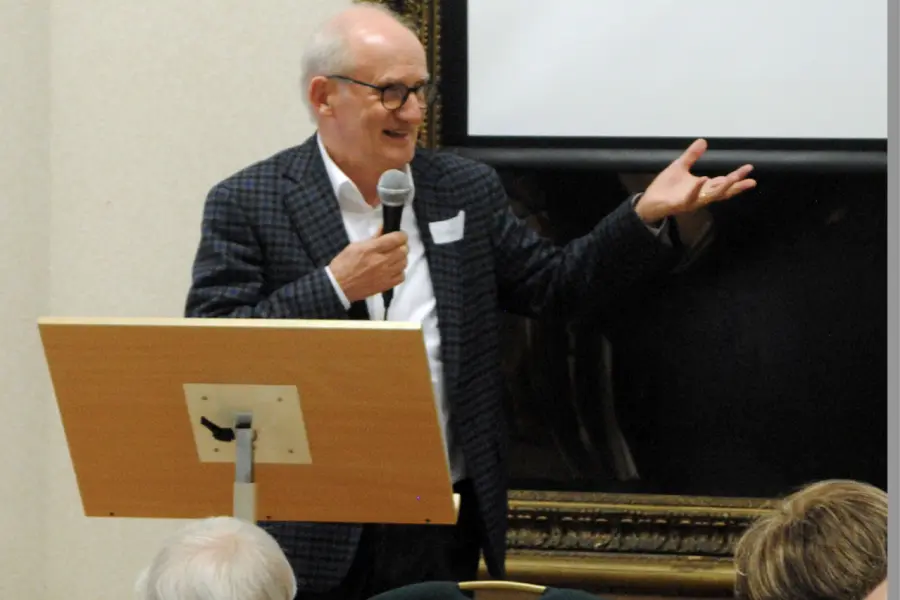
There were four speakers. Mary Cullen set the context with an account of the way in which today’s Scottish Catholic Church was shaped by its history; Fr Tom Magill described Scotland’s synodal journey to date; and Sister Gemma Simmonds gave a powerful reflection on faith and discernment. The final speaker, Professor Werner Jeanrond, responded to what he had heard in the course of the day and placed it in the context of the wider European church.
Synodality
The round table discussions which took place throughout the day revealed an overwhelming welcome for synodality as a way of being church. People who had experienced it in their parishes described it as a productive and inclusive process. One group said they appreciated the ‘mini experience’ of the synodal process at the conference. Another noted that synodality does not undermine the authority of the church but is a ‘positive way forward’. We are, said one group, at the start of a process and the Holy Spirit is with us.
‘Speakers were very good. They introduced a level of reality and honesty that was much appreciated’.
There was deep concern from people from parishes where little or nothing was being done to introduce synodality. Some said they were unaware of the synodal process. Others spoke of synodality as a ‘postcode lottery’, dependent on parish priests. There was a sense of frustration, of hopes not realised. We are waiting to hear more about synodality one group said: how does it become the working culture of the church? Is there a disconnect between clergy and laity? One group highlighted a lack of leadership in the church.
The need for formation
There was a strong sense of the need for ongoing formation in synodality for priests and people, in seminaries, parishes and dioceses, ‘to bring synodality into church life; to replace the hierarchical model with shared responsibility; and to include young people who grow up outside the church’.
The need for clearer, simpler language was noted by several groups, and the need for ‘well formed pastoral councils with a truly synodal approach’.
The challenge of change
There were many reflections on the need for change, which one group described as ‘difficult, uncomfortable, challenging’. We are held back by convention, by clericalism and by lack of progress in the implementation of Vatican II, another group suggested. Clergy are not trained for the model of church as field hospital which Pope Francis advocates, noted another. Lay people are more engaged than priests with faith in the secular world: we need to work together.
We live in the world, noted one group in capital letters. How can we remain open to and loving in to-day’s culture in the light of scripture, asked another. One group highlighted the importance of engagement with Catholic Social Teaching, of looking outwards, and developing an awareness of different ways of practicing faith. They stressed the importance of inclusivity and concern for the poor.
A series of questions were recorded by note takers. How do we encourage fuller participation of all? How do we change the culture of the church? What is the vision of synodality? Are all voices being heard?
‘A very stimulating day and a real encouragement to keep going when my local church experience is definitely non synodal.’
A response to the day
In his talk, Professor Jeanrond welcomed the process toward synodality in the worldwide Roman Catholic Church and expressed his gratitude for the many pertinent insights from the day’s conference. He also reflected on the Synthesis Report of A Synodal Church in Mission published by the Vatican 2023; on Pope Francis’ Encyclical Letter Fratelli Tutti of October 2020, and on the Czech theologian Tomas Halík’s book The Afternoon of Christianity: The Courage to Change (Notre Dame, Indiana: University of Indiana Press, 2024).
At the moment, he said, the Church is undergoing a radical reform: from a salvation institute for individual souls toward a new communal focus on God’s coming reign (or Kingdom) in our universe. The focus thus has shifted from an urge away from this world toward transforming this world in God’s Spirit of love. Moreover, this reform includes new ways of being Church together, including the process of synodality in which everybody is to be listened to and respected. God speaks through every person – notwithstanding their hierarchical rank or ecclesial privilege.
All Christians are part of this reform process because of their baptismal grace. Thus, God calls women, men, and children, to love, hope, and faith, and not to becoming clerical representatives of the Church in the first place. Therefore, the concept of laity or lay-people (literally: ‘people people’) would need to be abandoned in favour of a genuine approach to a synodal church in which every baptised member is co-responsible for the whole. In the past, laity meant non-clergy. In the future, such clericalism must be overcome – both among clergy and laity. Instead, all offices in the Church are understood in terms of service, not in terms of absolute power or privilege. Such a change would necessitate even a review of the sacraments of ordination of priests and bishops. In this regard, the position of women and their service in the Church must be radically reconsidered.
In Europe, the Church finds itself in rather different situations and contexts. In Germany, the lack of priests has led to powerful administrative reorganisations of parishes, including the destruction of functioning forms of Christian community. Thus, a clerical approach to Church has helped to destroy Christian communities. Theologically, it is evident that God calls people into community. Hence, we need to contemplate what genuinely synodal forms of community might be demanding from all of us.
In other parts of Europe, such as in Sweden (a Roman Catholic diaspora situation), there is no shortage of priests. This had misled the bishop to believe that no reform of Church was called for. The ongoing revelations of spiritual and sexual misuse of children and vulnerable adults in the Church call for a radical reform of power structures and for a new transparency of service.
The new call to mission ought to be welcomed. However, as expressed more clearly in Fratelli Tutti than in the Synthesis Report, mission makes sense only as a mission of love. Love respects the other – the fellow human, God, God’s project of creation and reconciliation, and the other in my own emerging self. Mission without love is bound to miss God’s emerging reign. Moreover, faith in the sense of mere assent to doctrinal propositions might eventually emerge from a mission of love, yet it cannot be the aim of such mission. In short, faith without love is bound to lead to idolatry.
Trust and belief in Jesus Christ and emerging forms of discipleship are not the sole possession of the Church. In other words, as Pope Francis does not tire of pointing out, Christ must be found in but also outside of the Church – even among the so-called nones, i.e. those people who have lost faith in the Church but not necessarily in Jesus Christ.
As Halík emphasizes, Jesus knocks from within the Church and wants to get out in our world and we ought to follow him. A new ‘ecumenism’ emerges when Christian disciples are moved by God’s gift of love. Spirituality, emancipated from narrow approaches to Church, invites a new pilgrimage among churched and non-churched people on their way to God’s reign. Once again, love is at the centre of this pilgrimage, and a faith without love would be misleading.
‘The river of faith has moved away from its former banks; the Church has lost its monopoly on faith. … But the Church, as a community of believers, a community of memory, narrative, and celebration, has an enduring mission to serve the faith, both by its historical experience and, above all, by the power of the Spirit who dwells and works even within ‘clay jars’. Halík (p. 184).
Reading today the signs of the time might urge Christians in all traditions to discover afresh where in our troubled and fragmented world Jesus Christ is to be found and followed. This discovery is not easy or straightforward, but most certainly exciting and promising.
Werner G. Jeanrond, a native of Saarbrücken in Germany, has taught theology at the Universities of Dublin (Trinity College), Lund, Glasgow, Oxford, and Oslo. Among his publications in English are Theological Hermeneutics, A Theology of Love, and Reasons to Hope. He is currently working on Faith and Love, the third and final volume on the theological virtues. He is retired and lives in Saarbrücken. His books and articles have been published in many languages. He holds a PhD in systematic theology from the University of Chicago and an honorary DD from Regis College in the University of Toronto.
The Open House conference was supported by the Xaverian Missionaries.