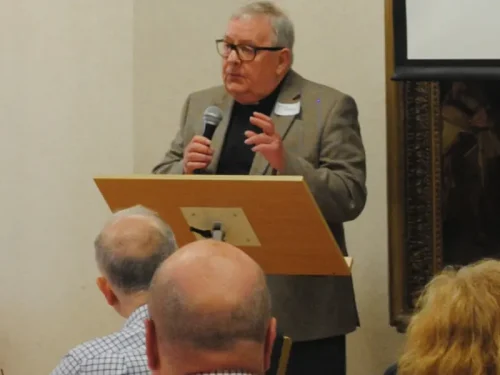
Synodality in Scotland
by Tom Magill
In this paper, I hope not only to outline where we are at in the Scottish Catholic Church regarding synodality but also to offer some theological reflections on the contributions both from the dioceses and from the national reports. The paper has three main sections: What is synodality? How do we live synodality? The outcomes of the consultations.
Section one: What is synodality?
This section has four parts: Synodality as a new way of being and working as church; the process so far; Synodality as a style of being church; Synodality as a mark of the Church.
A new way of being and working as church
Let me begin with a brief definition of Synodality. Synodality is the new way of being and working as Church presented to us by Pope Francis through which all Catholics by virtue of their baptism are co-responsible for the life and mission of the Church. Synodality is the means to renew constantly and consistently an evangelising Church. In this vision of Church, all Catholics are to be involved in all decision-making processes at every level of the Church, parish, diocesan, and universal, and should be encouraged, indeed mandated, to do so by Church leaders.
This ecclesiology has discombobulated many, not least the clergy, in its presentation of what it is to be Church. And yet it shouldn’t. It is an ecclesiology with deep roots in the teaching of the 2nd Vatican Council specifically in the vision of the Constitution Lumen Gentium, an ecclesiology which takes this vision seriously and tries, perhaps for the first time, to put it into practice. This vision of Church does not subvert the authority of bishops and priests, or undermine the Tradition, as some might fear. Synodality, rather, is the action of the whole Church together which respects and enhances the charisms and offices of each of her members. ‘Differentiated co-responsibility’, a term used in the most recent reports from France and Ireland, is the description which seems to be gaining traction. This is clear in the distinction made between decision-making and decision-taking. Decision-making (the participation of all) is the process which leads to decision-taking (the action of the competent authority). As part of the decision-making process, the bishop or priest together with the people proceed through listening, prayer, dialogue, and discernment to come to a decision and to ensure it is acted on. Pope Francis reminds us that this is not somehow akin to a parliamentary process which leads through argument to a majority decision. Rather, this is first and foremost a spiritual process which opens the participants to the action of the Holy Spirit and enables them to reach a consensus even if not unanimity on the matters discussed. What it does clarify, however, is that any decision-taking without the decision-making process is seriously deficient.
The process so far
Before proceeding further, it’s worthwhile looking at where we find ourselves in this synodal process and its timeline. There are three phases to the synod: The consultation of the People of God; The discernment of Pastors; The Implementation of a synodal church.
In Phase 1 each diocese/ecclesial body and the equivalent for the Oriental Churches produced a synthesis of all the reports from parish or local level. (October 2021-Autumn 2022). The bishops of Scotland directed that there be a core working group in each diocese which would nominate a priest and/or a lay person (preferably a woman) to represent them at the national body chaired by Bishop Brian McGee. Overall, this seems to have worked quite well. Each diocese succeeded in producing a report from which the national synthesis emerged.
Because of the pandemic, some dioceses used online questionnaires and surveys for their reports. While understandable, this was not ideal since it did not allow the people to participate in the most important thing – how to experience and learn what a synodal Church might look and feel like.
Apart from the dioceses, other Catholic organisations in Scotland also contributed, most especially the Scottish Laity Network. This group meets online and contributed greatly to the reception of the synodal process in Scotland. As they prepared their contribution, they hosted important speakers on a regular basis, scholars such as Gemma Symonds, Rafael Luciani and Massimo Faggioli, who both formed and informed them in synodality. Mention should also be made of Open House magazine which has published and will continue to publish regular updates and reflections on the synodal process in Scotland. Both Open House and the SLN have done sterling work in keeping synodality alive in Scotland, something the October first session of the Synod asked everyone to do. It’s incumbent on all of us to promote their presence. The 1st Phase concluded with the Continental Report which was the synthesis of the national reports for each of the continents.
From these reports, the Secretariat of the Synod prepared an Instrumentum Laboris (Working Document) for the 2nd phase, the Discernment of Pastors. This took place in in the first session of the Synod last October. The participants produced a synthesis report, the Church in Mission, sent out to all local Churches with an invitation to respond as they did in the 1st Phase. These responses will be part of the Working Document for the 3rd phase in October, the Implementation of a Synodal Church. This is where we find ourselves at the present moment and this Conference is part of that response. I will comment later on the diocesan responses to the Church in Mission document and the national report synthesised from them.
Synodality as a style of being church
It should be noted that synodality is first and foremost a style of being Church. It is about the ‘how’ before it is about the ‘what.’ The synod meeting in Rome last October showed this quite well. The participants found themselves in a learning curve getting to know what a synodal style is: listening, praying, dialoguing, discerning. There was a certain disappointment among some Church members and in the media that few decisions regarding ‘hot topics’ were made. This was because they put the ‘what’ before the ‘how.’ Synodality is not first and foremost about changing Church structures or establishing strategies of renewal; rather it is about a change of culture, of moving from how we live and relate and do things at present to a new mode of being Church. ‘Culture eats strategy for breakfast’ is a famous quote from legendary management consultant and writer Peter Drucker. By this he didn’t reject the importance of strategy but rather he stressed that it must emerge from a change of culture which would empower, give responsibility and include, and not be restricted by previous rituals and routine and ways of doing things. Perhaps this is a reason why Pope Francis has split the XVI Assembly of the Synod into two sessions, a year apart. This gives the participants the opportunity to learn first how to be a synodal Church. Some dioceses in Scotland have recently established renewal programmes without, it would seem, much reference to synodality. They have put the what before the how, strategy before culture.
Synodality as a mark of the Church
Pope Francis is helpful here when he calls synodality a mark of the Church alongside One, Holy, Catholic, and Apostolic. These marks are so to speak ‘givens’ – they define how the Church lives and operates, what the culture of Catholicism is. When this become disturbed or damaged by specific strategies, the entire culture of the organisation is deeply undermined to the extent that a cultural shift is demanded. This cultural shift is what can happen when the One, Holy, Catholic, and Apostolic marks of the Church are understood in a synodal key. With the clergy sexual abuse scandal, the Scottish bishops realised that the previous way of doing things, the culture, had to change in the light of which new strategies could emerge. The Scottish Catholic Safeguarding Standards Agency is a good example of a new strategy. The new agency is professionally lay-led and independent with a remit to assure and promote safeguarding standards across all Catholic Church jurisdictions in Scotland. Here we see the bishops sharing their authority with a lay agency and so renewing the marks or culture of the Church in a synodal manner. The authority of the bishops as decision-makers is not only not undermined but enhanced and consolidated.
Section 2: How do we live synodality?
There are two parts to this section – conversation in the Spirit and formation in synodality
Conversation in the Spirit
How concretely do we put synodality, this new way of being and working as Church, into practice? The biggest contribution the October synod gave to the universal Church, it can be argued, was Conversation in the Spirit constructed around listening, praying, dialoguing and discerning. The Synod urges this methodology to be used at all levels in the universal Church.
The methodology of Conversation in the Spirit.
There are four steps involved, firstly, each individual takes time for prayer and reflection on the topic to hand. This can be done alone or in the group, with the prayer grounded for example in an appropriate passage of Scripture. The group comes together in small groups around tables and begins the next step. Each person in turn speaks to the topic with the rest of the group listening respectfully without responding or commenting. The third step invites each individual in turn to describe what has resonated in them from what they have heard, or how resistance had been experienced. This is a response moment not a time for the participants to expand upon what they have said in the second step. The fourth and final step is a time for dialoguing, identifying convergences, discordances and new questions which arose. There should emerge a consensus regarding the outcome of the process with each individual feeling that they have been heard. The moments between each step is marked by silence. Conversation in the Spirit is thus the discernment process of decision-making leading to decision taking by the competent authority. It is an experience of deep listening. One bishop who participated commented that when he first heard of this methodology he thought it was pious nonsense. After he experienced it, he was totally converted to it. In our dioceses, Conversation in the Spirit where used proved to be immensely popular and productive.
Formation in Synodality
Last year’s October assembly designated these months before this year’s Assembly as a time of formation for both clergy and laity into becoming a synodal Church. Synodality cannot be seen simply as a new model or institutional way of being church. Rather, as one of her essential characteristics, it becomes a constituent and constitutive dimension of the Church. Rafael Luciani notes:
‘It is therefore important to recognise that synodality, as a constitutive dimension, is more than a synod, and it is also more than a mere method: it is a principle, and it is a hermeneutics of reconfigured relationships and communicative dynamics among all ecclesial subjects that sets in motion an integral, organic transformation of the whole church’.
He calls this ecclesiogenesis, an on-going state of conversion and reform which creates the possibility to view all ecclesial structures, subjects, relationships, and modes of operating within the hermeneutic of the People of God. This picks up nicely the eschatological nature of the Church as a people in via, journeying together, ready and able to discard culturally determined forms and structures in order to more fully express the mind of Christ. For Pope Francis, this new way of being and working as Church must be rooted in its evangelizing nature so that renewal must have mission as its goal. This going out to the peripheries aims to save the Church from damaging introspection, self-referential thinking, and self-serving attempts to protect the institution at all costs. Specifically, as we have seen, formation in the methodology of Conversation in the Spirit was highly recommended. Unfortunately, there does not seem to have been a widespread uptake of this in all our dioceses. This is surprising given the enthusiasm especially among the laity who participated in the consultation for the first session.
Section 3: Outcomes of the consultations
I have seven parts in this section – the two National Reports, Speaking and Listening in the Church, Listening to the World, the Common Priesthood of all the Faithful, the need for Formation of all the Faithful, the Centrality of the Liturgy and the Paschal Mystery.
The two National Reports
These reports synthesised the diocesan reports which themselves were syntheses of parish reports. Apart from one, all the dioceses in Scotland have a Synod page prominently displayed on their websites, some with more information than others. The Bishops’ Conference website has only the first national report displayed under the Resources section.
The first consultation worked quite well, the second in response to the document Church in Mission from the Synod assembly last year less so. There seems to have been much less participation. One diocese failed to produce a report, another submitted a report which gave the impression that no consultation had taken place, was the work of one hand, and focussed almost entirely on the topic of the family. Another diocesan report noted that only four parishes had responded. Another had one on-line consultation with laity. Three reports described the renewal strategies they had in place but with little reference to synodality. Only one diocese had any extensive consultation.
The national report makes some specific proposals – the expansion of existing lay ministries and the creation of new ones, the expansion of the role of women in the decision-making process of the Church and in pastoral care and ministry, programmes for the joint formation of the People of God, an ecumenical commemoration of the anniversary of the council of Nicaea. But it does contain a lot of ‘musts’ and ‘needs to,’ and quite a bit of repetition of the content of the 1st report.
Last year’s synod assembly asked us to reflect on 2 questions: ‘How can we enhance the co-responsibility in mission of the People of God?’ and ‘What structures and processes of decision-making can be renewed or introduced to help enable that co-responsibility?’ Pope Francis encouraged us during this time to learn how to be a synodal Church. There is little evidence of that in the 2nd national report. Neither is there much advocacy for synodal structures within our church. Missing too in that report are specific and concrete examples of how dioceses and parishes are already practising synodality. By way of contrast, the Irish national report is full of them. So there does seem to be a bit of synodal fatigue and a missed opportunity to be imaginative, specific and indeed bold, the parrhesia of which Pope Francis speaks so much.
Speaking and listening in the Church
Perhaps the most important outcome of the synodal process in Scotland was the appreciation people felt at being listened to and given space to speak. This was noted in all the diocesan reports. Our dialogue begins with listening to God’s Word, listening to our inner response and respectfully and silently allowing others to speak their story on the road, one parish report noted. This reveals a growing understanding of Catholic life as dialogical, interpersonal, and dynamic among all members of the Church. The stark distinction between the teaching Church (ecclesia docens) and the learning church (ecclesia discens) in this way is attenuated. The Church’s teaching and learning becomes a virtuous circle in which all are involved.
For this new culture which gives room and time for all to listen and speak to be embedded in our common life will require a cultural change with strategies at the diocesan and national level here in Scotland. All have a voice where all are involved. It is no longer adequate to say that the laity simply have to learn and understand better the teaching of the bishops. There must be an on-going reciprocity and mutuality which regulates the understanding of the faith and comes from a single common effort on the part of the bishops and the laity to discern the sensus fidei totius fidelium. All the faithful together through baptism are charged with this task of discerning and deciding how to carry out the Church’s evangelising mission. Viewed in this light, the laity’s role in the Church can no longer be seen as delegated or secondary but must be seen as deriving directly from Christ through baptism and strengthened and nourished through the other Sacraments.
Clearly this has implications for the clergy. The validity of decisions handed down from on high will be questioned and perhaps not received. A good example of that old way of operating is the choice of a new translation of the Lectionary made, as far as can be seen, with no consultation with the people. Gradually, I think, we will come to see that way of doing things as quaint and bemusing. The 2nd national report in response to the Church in Mission document recommends that a ministry of listening and accompanying be established in the Church in Scotland, (16) while at the same time noting the hesitation among some regarding this way of communal discernment. (1)
Listening to the world
There was also a general consensus in the diocesan reports on the need to listen to the world. It is clear that most Catholics no longer see the Church as an island of grace in a sinful world. The reports showed, for instance, that people are no longer willing to ostracise family members who may be in so-called irregular situations – cohabitation, divorced and re-married, LGBTQ+. Rather there is a clear awareness that the Church is deeply part of this world, journeying with and alongside all humanity, no longer restricting herself to judgmental and punitive approaches, as another parish report noted.
Here it should be said that the laity have taken to heart either consciously or unconsciously the teaching of Gaudium et Spes, the Pastoral Constitution of the Church in the Modern World of the 2nd Vatican Council. There is a desire to be an outward and inclusive Church in which all have a place and a rejection of a Church which is self-serving, self-referential, and introspective. This signals not just the importance of being aware of events in the world but of a recognition that a persuasive presentation of the faith cannot dismiss or ignore what is happening in the world without losing credibility. This is seeing the signs of the times as particular insights into humanity that could provide the material needed for the Church’s dialogue with the modern world. The present ecological crisis, for instance, a number of parish reports noted, must be addressed by the Church in terms of the Gospel and Christian faith. The mission of the Church is, crudely put, not simply the salvation of souls. There was no desire expressed for the Church to become involved in culture wars or to return to a so-called golden age of seeming certitude. Put more theologically, this means the Church offers humanity what it has received from God and in turn receives from humanity new ways for God’s truth to be contemplated and proclaimed. The revelation from God in the past becomes the means of discerning his revelation today. Mirroring the Incarnation, the missionary Church enters the suffering and anguish, the joys and hopes of the world.
Evangelisation, then, is not first and foremost the teaching of a body of doctrine but rather a personal, concrete witness to the presence of Christ in the believer. It takes place in encounter, in a relational context through which the presence of Christ is experienced in mercy, accompaniment, and listening. Mutual transformation emerges in the missionary experience. It is important to understand that this model of evangelisation is deeply ecclesial. It allows the believer and the non-believer alike already to experience the community life of the Church both at the universal and local level.
It is in this experience of encounter and walking with individuals that the Church undergoes conversion (metanoia) and self-emptying (kenosis) after the pattern of the Paschal Mystery. Indeed, when the Church becomes the environment in which the life of all is nourished in mutual selfless love, it grows in doctrinal wisdom and understanding and becomes ever-more an image of the Trinity in its communion, participation, and mission. A synodal church is not only the driver of this but a more synodal church also is born out of this. Through evangelisation and synodality the Catholic Tradition is ‘handed down’ both to the Church and the world. From what has been said, it becomes clear that Tradition is not something static and fixed, a body of truths or inherited beliefs, or a ‘deposit of faith’ which is articulated immutably in a formula of words. When the 2nd Vatican Council stated that both Scripture and Tradition flow from the same divine wellspring, it rooted both in the dynamic life of the Trinity in whose life all the baptised share. The proclamation and handing on of the faith is an announcing of the present action of the Spirit in our Church and world which brings the communion, participation, and mission of the Trinity into our contemporary situation and experience.
Many participants in the synodal process expressed their commitment to this handing on of the faith to the next generation and to the world but expressed uncertainty about how best to do this. There is much work to be done in this area. What is clear is that this work of proclamation and handing on is entrusted to the entire body of believers, according to the charisms and offices which each has received. Together with synodality, reading the signs of the time represents a method in theology which takes seriously the lived experience of contemporary men and women. This reflects well Pope Francis’ call for an inductive and contextual theology. The 1st national report registers nonetheless a certain hesitancy in the church’s dialogue with the world when it notes: ‘In the dialogue between Church and society, there is at times uncertainty regarding what the Holy Spirit is saying to the Church through changes in society and what the Church has to offer the world.’ (6)
The common priesthood of all the faithful
If the teaching of Gaudium et Spes has been understood and lived, it’s clear that this is less the case for Lumen Gentium, the Council’s Dogmatic Constitution on the Church. The fundamental equality and dignity given to all through baptism which is more fundamental to distinctions of Office, Ordination or ecclesiastical competence was news to many. Bishop McGee commented that the common priesthood of all the faithful rooted in Christ’s Priesthood and received in baptism was equally not commonly known and understood.
Viewed in this light, the common priesthood of all is prior to and the prerequisite for the ministerial priesthood. The ordained still belong to this common priesthood within which and for which they serve their ministry, and to which they remain subordinated. Synodality serves to integrate the ordained leadership of the Church into the totality of the People of God as Christifideles. The primacy of hierarchical communion is displaced by communion of all the faithful.
It is this profound understanding of all the faithful sharing in Christ’s threefold ministry of priest, prophet, and king which gives real agency to all the baptised for full, conscious, and active participation not only in the liturgy but in all Church affairs. It is because of their baptism that all the faithful become missionary disciples and it is only within the People of God that the hierarchy, as Christifideles themselves, can exercise their ministry and be clear about their identity. Bearing the image of the Trinity in its mutual giving and receiving, the People of God has the Logos, the Word, at its heart and the Spirit as its prime mover. This means that all the faithful together bring this Word, heard and responded to, incarnate in their lives, to the teachings of the Church. A relational anthropology is pre-supposed. To put it another way, they can act as subjects, as people with agency, rather than objects who passively receive. Indeed, it is incumbent upon the entire people of God to do this. Here we see a deeper theology of baptism emerging. Both the 1st and 2nd national reports show that the laity have already an inchoate understanding of this theology and are open and ready form deeper formation. The 2nd national report, however, has little to say about this fundamental equality and dignity of all the faithful. It still regards the laity in terms of ‘resource’ and ‘expertise’ (8) and fails to consider at length their baptismal role in the mission and governance of the Church.
The need for formation for all the faithful
From this and other matters discussed, the recognition of the need for formation in faith appeared in all the first diocesan reports. We are thirsty for the inspiration that drove the Church after Vatican II and would like to get back to the energy of the past, one parish report noted. There was a general recognition that this formation was not simply about personal growth or intellectual curiosity but was to further the missional and evangelising purpose of the Church and to deepen its call to the holiness of all members. ‘This requires formation similar to the four dimensions of seminary formation, namely, spiritual/liturgical, pastoral, intellectual and human formation. It was recognised that significant investment would be required for this project’ the 1st national report commented. (3.3) Bishop McGee emphasised strongly the need for human formation among all the faithful, laity and ordained alike.
It was noteworthy that in many places at parish level during the periods of reflection and conversation, the parish priest was either absent or did not take part. In many cases, I suspect, this came out of a desire to give freedom to parishioners in their discussions. Here it should be noted that when the conciliar documents use the term christifideles they refer to all the baptised both lay and ordained. The English translation faithful is all too often restricted to the laity. We should remember then that the clergy when they are ordained don’t leave the common priesthood of all the faithful behind. This led the Synod Assembly last October to underline the need for formation especially in synodality, but with clergy and laity together reflecting the common priesthood of the faithful in which all share. Formation then should be seen not as something done to the laity but as an aspect of our common life together in Christ. The 2nd national report proposes ‘that priority should be given to providing programmes designed and intended for the joint formation of the entire People of God (laity, consecrated and ordained ministers),’ (14) especially given the difference between how synodality is being received by the clergy and the laity respectively.
The centrality of the liturgy
The 1st national report reflects this approach especially on formation in the liturgy: the need for quality liturgy, good preaching, liturgical music and lay participation in liturgical roles are all mentioned. But it emphasises that this liturgical formation is required for both laity and clergy as the liturgy does not belong to the clergy but to the whole People of God. (3.2) Most especially, it talks of the eucharist as ‘a remedy rather than a reward, so that it becomes an ongoing experience in the journey of faith and maturing spirituality’ (3.22) offering ‘welcome those who are divorced, those who have had abortions; those of different sexual orientations, those who lack the inner conviction of realising that they have faith.’ (3.2)
The Paschal Mystery
A deeper reflection on the liturgy sheds light on the synodal process. At the Council there was a move away from understanding the Mass solely as Christ’s expiatory sacrifice to a more-broad view of the liturgy as the experience and celebration of his Paschal Mystery. We see a move from spectating or attending to deep participation and inclusion. The term Paschal Mystery describes the arc of Christ’s self-emptying love leading to new life and glory and the entry into and participation of the faithful in this. Pope Benedict called the Paschal Mystery the centre of what it is to be Christian and perhaps the most fertile theological idea of the last century. The term peppers the documents of the Council as it does the teaching of Pope Francis. Many lay participants appreciated deeply the spiritual nature of the synodal process and felt that there was something profound happening. Intuitively, I think, they understood they were getting to the heart of Christian living, that the Paschal Mystery was spilling over into their encounters with each other, and that they were coming to see it as the paradigm and pattern of the Christian life. This is what Pope Francis means when he talks of the sacramental/liturgical dimension of synodality. Good Friday, Holy Saturday and Easter Sunday present in every liturgical act should also be evident in Christian living and encounter. By stressing that synodality is a spiritual process he is saying that is an experience of the Paschal Mystery, coming from our celebration of the Liturgy and returning to it.
This celebration and experience of the Paschal Mystery point to the Trinitarian dimension of the Synod in its liturgical and sacramental aspects. The Synod’s key words of Communion, Participation, and Mission show how this synodal process is rooted in the life of the Most Holy Trinity and which is shared by the community of believers. Both national reports reveal how readily participants understood the spiritual nature of the synodal process. It’s unfortunate that the 2nd national report had nothing to say about our celebration of the liturgy and how it reflects and moulds our sense of communion, participation and mission.
Maybe we are still in a long Holy Saturday, lying in the darkness of the tomb with Christ, unsure, uncertain of the way forward, reconfiguring our idea of being Church, waiting for the light to come.
Viewed in this light, a synodal Church will always experience dying, lying in the darkness of the tomb, and rising to new life. If the three aspects of the Paschal mystery become disjointed, then the Church itself becomes a place of only hopelessness and negativity (Good Friday), or of uncertainty and darkness (Holy Saturday), or of triumphalism (Easter Sunday). Of course, at times one aspect may dominate, but held together dynamically they take seriously the full human and Christian situation. Perhaps we can say that in recent times we have experienced deeply the Good Friday experience in the abuse crisis, that recognition that we have to stand in solidarity with survivors in their pain, and die to old ways of being Church. Maybe we are still in a long Holy Saturday, lying in the darkness of the tomb with Christ, unsure, uncertain of the way forward, reconfiguring our idea of being Church, waiting for the light to come. But for sure, a synodal Church will be a Church which has the Paschal Mystery at its heart.
Sources:
The national report from Scotland can be accessed on the website of the Catholic Bishops of Scotland website: www.bcos.org,uk
The General Secretariat of the Synod has one Advisory Committee and four Commissions – the theological, the spirituality, the methodology and the communication Commissions.,
Synodality. A New Way of Proceeding in the Church (New York, Paulist Press 2022) 74
“This dynamic vision of synodality presents the Church in its historical dimension in a state of permanent birth, in an on-going process of reform. It lets us perceive that the identity of the Church is a dynamic identity, not a static one; it is a relational identity of communion-mission rooted in the Trinitarian mystery and the Eucharistic mystery.” Nathalie Becquart, “Synodality: Towards a Renewal of Ministry,” in The Synodal Pathway. When Rhetoric meets Reality, ed. Eamonn Conway, Eugene Duffy, Mary McDaid (Dublin: Columba Books, 2022), 72.
“Synodality, in Francis’ regenerative conception, allows for the full ecclesiological consequences of the Church as the people of God, and is inextricably bound up with a call for a missionary, centrifugal Church, ex natura ad extra, in which ordinary believers take responsibility for evangelising our world as missionary disciples.” Austen Ivereigh, “Pope Francis’ Vision of a Synodal Church: The Spirit in the Assembly,” in The Synodal Pathway, 33
“Singularis antistitum et fidelium conspiratio,” Dei Verbum 10. “The Spirit has not only been given to the bishops – hence collegiality – but to all the faithful. Here, the old distinction between a hierarchical teaching church and a lay learning church (ecclesia docens, ecclesia discens) has been surpassed. Once again, that does not mean the hierarchy’s role is abolished, but recontextualized: the ordained ministers can only discern the Spirit if they have first contemplated the Spirit’s (possible) work in the people as a whole.” Jos Moons, “Synodality, The Holy Spirit, and Discernment of Spirits,” in The Synodal Pathway, 83.
“The action of each particular agent within the community, whenever it is transformed by God’s grace, is the action of the whole community, because in this context ‘the building -up of each person builds up all, and the life of all animates each other.’” Looking East in Winter. Contemporary Thought and the Eastern Christian Tradition (London, Bloomsbury Continuum 2021) 164
“Synodality asks us to enter into something more than reform or development. It asks us to seek the grace and courage to make the Church an authentic community of love, with an openness to that which is other, a willingness to serve rather than rule, and a desire to follow Christ. We adhere to his truth not only for our own salvation but as the hope of all women and men, especially those forgotten, oppressed and exploited, those ‘excluded from the banquet of life.’ Synodality asks us to fall in love with the Church again and to love her as Christ does.” James Hanvey, “The Journey of Synodality,” Thinking Faith, July 2021.
“A correct exercise of synodality must contribute to a better articulation of the ministry of the personal and collegial exercise of apostolic authority with the synodal exercise of discernment on the part of the community.” International Theological Commission, Synodality in the Life and Mission of the Church, https://www.vatican.va/roman_curia/congregations/cfaith/cti_documents/... 69.
“The entire body of the faithful, anointed as they are by the Holy One, cannot err in matters of belief. They manifest this special property by means of the whole peoples’ supernatural discernment in matters of faith when ”from the Bishops down to the last of the lay faithful” they show universal agreement in matters of faith and morals.” LG 12. “[The church] transcends itself in a posture of openness and receptivity to God’s selfdisclosure … The whole Christian faithful are given a supernatural instinct for the faith (sensus fidei) that offers them an active role in the life of a “listening” church (LG 12). According to the council, the teaching of the magisterium is less a determinatio fidei, an independent determination of the faith of the church, than a testificatio fidei, an authoritative witness to that which the bishops have heard.” Richard R. Gaillardetz, “The Synodal Shape of Church Ministry and Order,” Concilium (2021/2): 99.
Rowan Williams talks of “the Christian community that held together the freedom of the person and the irreducibly communal and cooperative nature of human personhood.” Looking East in Winter. Contemporary Thought and the Eastern Christian Tradition (London, Bloomsbury Continuum 2021) 168.
Rev Dr Tom Magill is a priest of the Diocese of Motherwell. After graduate studies at the Pontifical Biblical Institute in Rome, he was Vice-Rector and acting Rector of the Pontifical Scots College, associate professor of theology at the Pontifical Gregorian University and lecturer in Sacred Scripture at the Pontifical Beda College. He taught Sacred Scripture at Chesters College (formerly Scotland’s major seminary). He holds a PhD from the University of Glasgow for his studies in the Gospel of Mark and lectured there in Biblical Studies.